How Does a Grease Trap Work? From Sink to Sewer, Part by Part
How does a grease trap work? It holds your kitchen’s wastewater still in a tank long enough for it to sort itself out. Fats, oils and grease are lighter than water and rise into a floating layer, food solids are heavier and sink to the floor, and the clearer water in between leaves through the outlet pipe for the sewer. A wall or fitting inside the tank keeps that floating layer away from the exit, so grease generally stays behind until your pumping company removes it.
This guide follows the water from your sinks to the sewer line, names each part on the way, explains how a small indoor trap differs from a large in-ground interceptor, and shows what changes when a trap is full and when it is broken. In Austin, keeping the trap working is the business’s job: Austin Water states that “All commercial and institutional food preparation businesses in the City of Austin must have a grease interceptor approved by Austin Water.”
How does a grease trap work in a restaurant?
Follow one sink of dishwater on its way out of the building.
- Into the drain line. Water from your sinks and floor drains runs down to the trap. On a compact indoor unit, a flow control device ahead of the trap limits how fast water can arrive, so the unit isn’t pushed past the flow it was built for.
- Through the inlet. Every drop enters through the inlet pipe. Where the trap has one, a fitting on the end of that pipe, the inlet tee, points the flow down into the water instead of letting it splash across the top, where it would churn up grease that has already risen.
- A pause in the first compartment. The water slows and cools. EPA’s guidance for kitchens describes the aim as giving grease calm, still water to cool and separate in. Grease rises into a layer on top. Solids drop to the floor.
- Under the divider. A baffle wall, or a fitting that does the same job, splits the tank. Water moves to the second compartment through the opening low down, and the floating grease generally doesn’t follow it under.
- A second pause. In a two-compartment tank, the water settles again and more of what got through separates out.
- Out through the outlet tee. The fitting on the outlet pipe reaches down into the water, so the trap lets out water from beneath the grease layer rather than from the surface.
- On to the sewer. The outlet pipe carries the water into the public sewer.
The grease and solids stay in the tank, building up between visits, until a permitted hauler empties it. For a closer look at the divider in step 4, see what a grease trap baffle wall does and why it breaks.
What are the parts of a grease trap?
The names vary between brands and plumbers, and not every trap has every part. The table pairs each working part with what it does and what can go wrong with it.
| Part | What it does | What can go wrong |
|---|---|---|
| Lid or access cover | Lets the trap be emptied, inspected and sampled without digging | A cover that no longer seals, or one blocked by equipment |
| Flow control device (compact units) | Holds incoming flow to what the unit is built to take | Missing, so the unit is overloaded |
| Inlet pipe and inlet tee | The only way in; turns the incoming water downward | A missing inlet tee: EPA lists backups in the kitchen and water short-cutting through the trap |
| First compartment | Holds the water still so grease rises and solids sink | Fills with grease and solids, leaving less room to separate |
| Baffle wall | Divides the tank and holds the grease layer back | Cracks, holes or collapse let grease ride through |
| Outlet tee | Draws water from below the grease layer | Corroded or missing, it can let grease out to the sewer |
| Outlet pipe | Takes the separated water on to the sewer line | Blocked, or damaged where it meets the tank wall |
| Vent or air relief | Lets air in so the trap doesn’t siphon itself empty | Blocked port |
| Walls and floor | Hold everything in | Concrete eaten by acid, steel rusted through, cracks |
Two parts appear on some traps and not others. A sample well is a small chamber at the outlet end, so whoever is checking the trap can draw off some of the outgoing water for testing. A cleanout is an access point on the outlet pipe, at or just past the trap, for clearing a blockage in the pipe itself.
Grease trap diagram
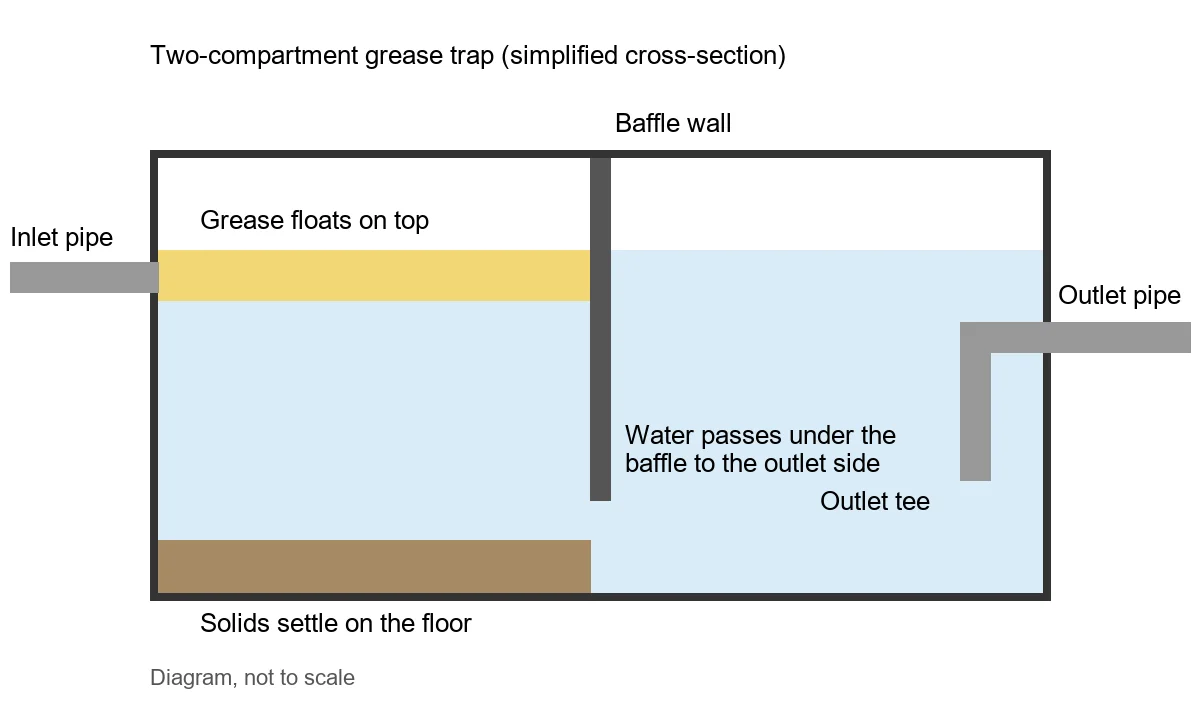
Reading the drawing from left to right:
- Inlet pipe: wastewater arrives from the kitchen.
- Grease layer: the floating band on top of the first compartment.
- Solids: the settled material on the tank floor.
- Baffle wall: the divider, with water passing beneath it.
- Second compartment: the calmer side, where more separation happens.
- Outlet fitting and outlet pipe: water drawn from below the grease and sent to the sewer.
Real traps also have lids over the compartments, for emptying and inspection; the drawing leaves them out.
Grease trap vs grease interceptor: what’s the difference?
In everyday use, very little. Austin Water’s own pages say grease traps are “also known as grease interceptors”. Its pretreatment FAQ draws a finer line: “Grease traps and grease interceptors both remove grease from industrial wastewater but use different designs.” The trade sorts those designs into two families.
Small indoor units
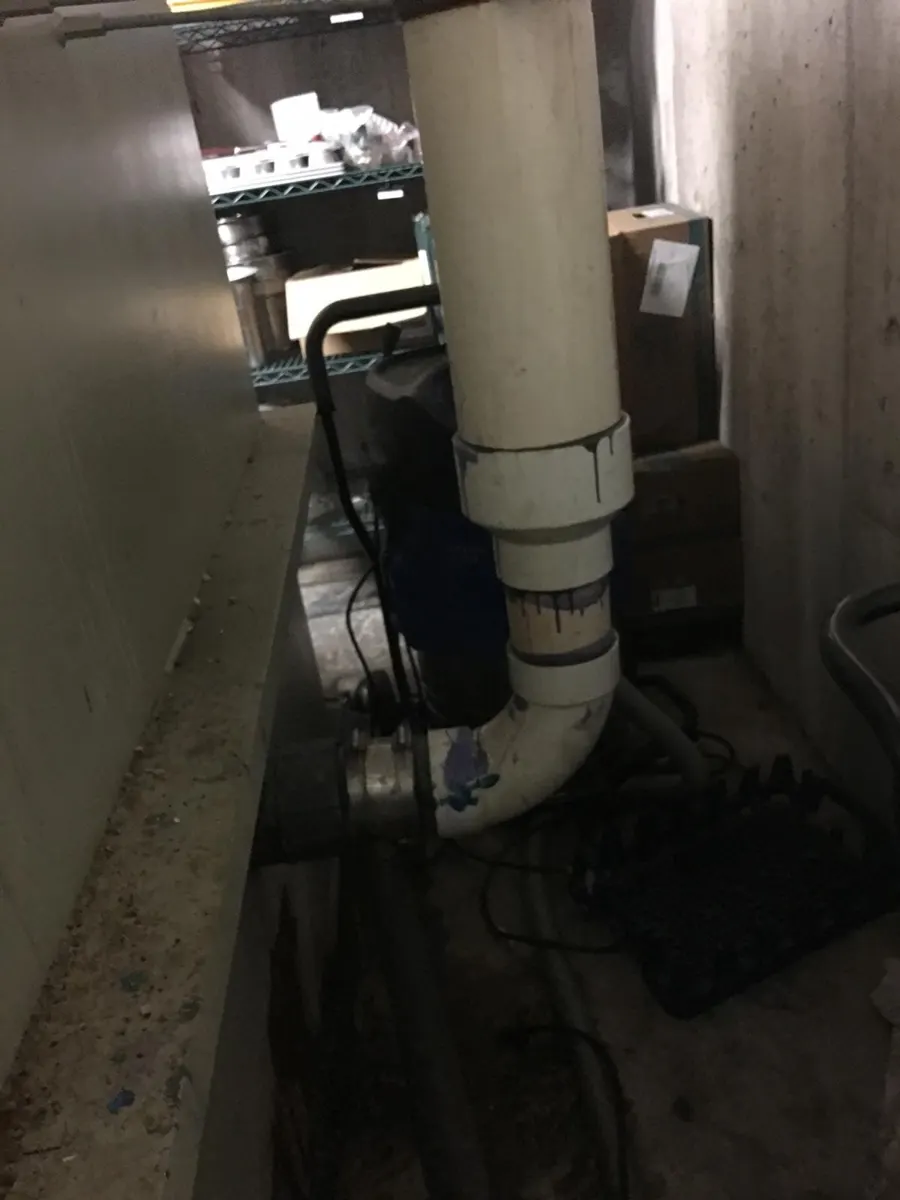
A hydromechanical grease interceptor is compact and usually sits inside the building, under or near the sinks. It separates grease using the way water flows through it as well as the difference in weight between grease and water. Austin Water describes these units as “typically single-compartment fiberglass or polyethylene units” and says a vented flow control device has to be installed upstream to match the unit’s certified flow rate.
Large in-ground interceptors
A gravity grease interceptor is a large tank, usually buried outside, that separates by weight alone: grease up, solids down. Because they work by gravity alone, these tanks need a long retention time, which is the time the water spends inside. Austin Water’s FAQ describes grease traps of this kind as typically “large pre-cast concrete tanks ranging from 250 to 10,000 gallons, with two compartments that allow separation and retention time.”
Which one do you have?
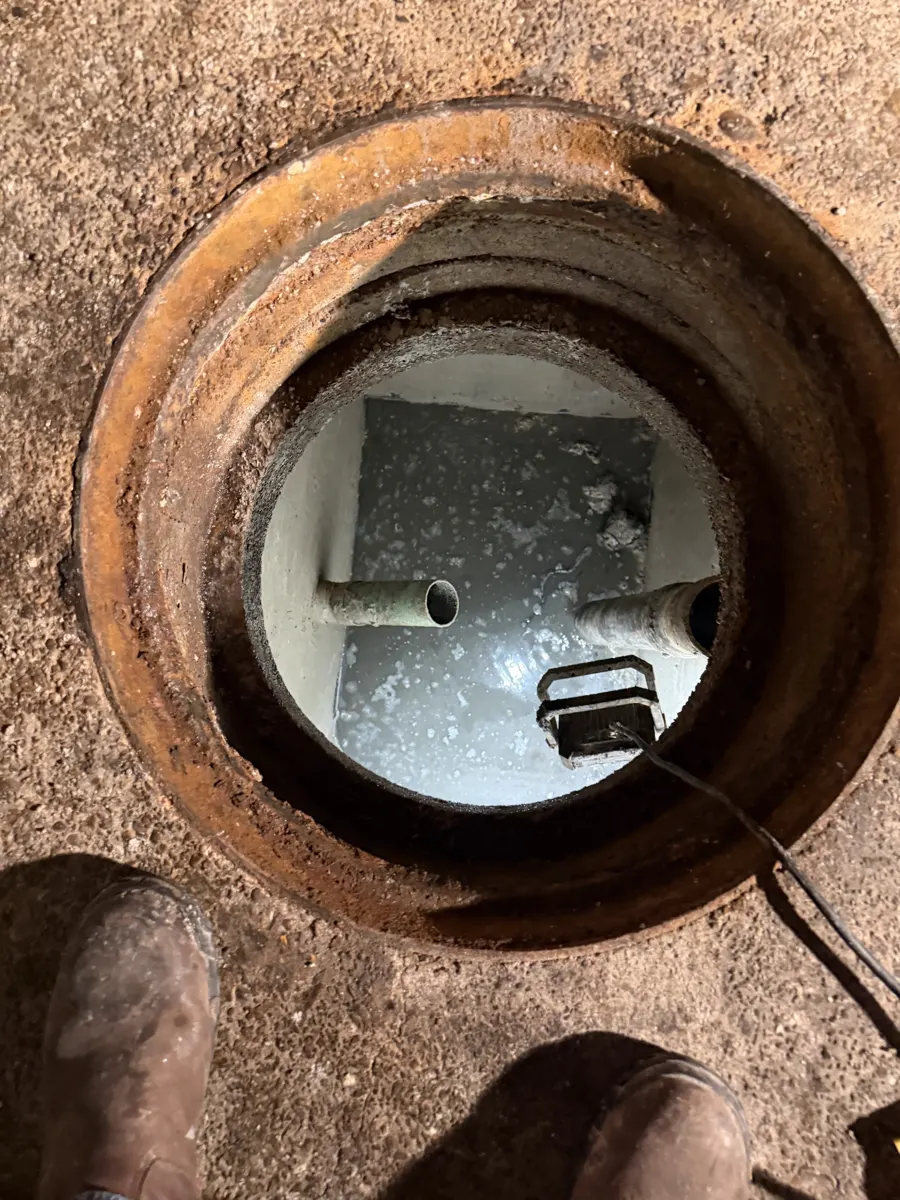
The quickest clue is where the lid is. A lid in the kitchen floor or a box near the sinks points to an indoor unit; a heavy cover set into the pavement outside points to an in-ground tank. Either way, don’t lift it to look inside. Gases such as hydrogen sulfide collect inside, and the opening counts as a confined space. Ask your pumping company what type and size of trap they empty.
If you’re planning a new trap rather than keeping the one you have, Austin sets the size and design before you buy. Before a new grease trap or interceptor is bought, Austin Water wants building plan approval and an Industrial Waste approval letter in hand, and it won’t approve units holding under 100 gallons. Grease trap installation in Austin covers what that process involves.
What happens when a grease trap is full?
A full trap still passes water, but it separates poorly. Grease thickens downward from the top, solids pile up from the floor, and the calm water between them shrinks. With less room and less time, more grease and solids can be carried out through the outlet tee toward the sewer line.
EPA counts grease as the most common cause of reported sewer blockages nationally, at 47%, because it hardens and narrows the pipe.
From the kitchen, grease service companies list these signs of a trap overdue for emptying: a rotten-egg smell near the drains or the trap, sinks and floor drains that drain slowly or gurgle, and water backing up into them.
Austin’s line for a full trap
Austin doesn’t leave a full trap to judgment. Austin City Code § 15-10-197 sets two triggers, and whichever arrives first applies. One is time: the trap is cleaned “at least every three months”. The other is depth: grease and solids taking up 50% of the wetted height, “as measured from the bottom of the grease trap to the invert of the outlet pipe”. The invert is the lowest inside point of the outlet pipe, so the wetted height is the depth of water the trap holds.
The same section says what a cleaning means. The business has to “completely remove all fat, oil, or grease waste, other liquid waste, semi-solid or solid and residue from the grease trap when the grease trap is cleaned”, so skimming the top doesn’t count.
A full trap is not a repair job. Call your pumping company: in Austin, the trap has to be emptied by a liquid waste hauler holding a City of Austin permit. We don’t pump traps. If the kitchen also wants the tank’s walls and fittings stripped of caked-on grease, that’s a different service, grease trap deep cleaning and degreasing.
Full, or broken?
If the trap was emptied on schedule and still backs up, smells or sends grease downstream, a part may have stopped doing its job. EPA’s training slides for operators name a missing inlet tee as a cause of backups in the kitchen. If your hauler finds the water standing low while nothing is draining, that points to a leak instead; see why grease traps leak, and where.
Your hauler sees the inside of the tank at every pump-out and can note damage on the manifest, the service record they give you. Austin Water is clear about that note:
“If a pump-out manifest provided to you by the LWH indicates that the GT needs repair, take appropriate action to have it serviced immediately.”
— Austin Water, Grease Trap Maintenance (LWH is the liquid waste hauler; GT is the grease trap)
When an inspection has already gone against you, start with the steps after a failed grease trap inspection.
Can a grease trap that stopped working be repaired?
Usually, yes. When a trap stops working, the trouble sits in one or more of its parts: a wall or floor with holes or cracks, a broken baffle, a corroded tee or pipe. Those can be repaired inside the trap you already have.
The damage mostly comes from inside. Decaying grease and food waste give off hydrogen sulfide gas. Bacteria living on the wet walls above the waterline convert the gas to sulfuric acid, which softens concrete, while the gas itself corrodes steel. Regular pump-outs shorten the time waste sits in the tank, but they don’t reverse damage that has already been done.
What we repair
We repair cast concrete, steel and fiberglass traps of every size, underground or above ground, and any part inside them: baffle walls, inlet and outlet pipes, T-pipes, deflectors, the floor and the walls.
It starts with a free on-site inspection, where a technician checks the trap and says what needs fixing. Your pumping company empties it first. The work itself happens overnight once you’ve closed: we clean and degrease the tank, fix every hole and crack, rebuild any broken walls and coat the whole interior. By morning the trap is back in service and the kitchen opens on time.
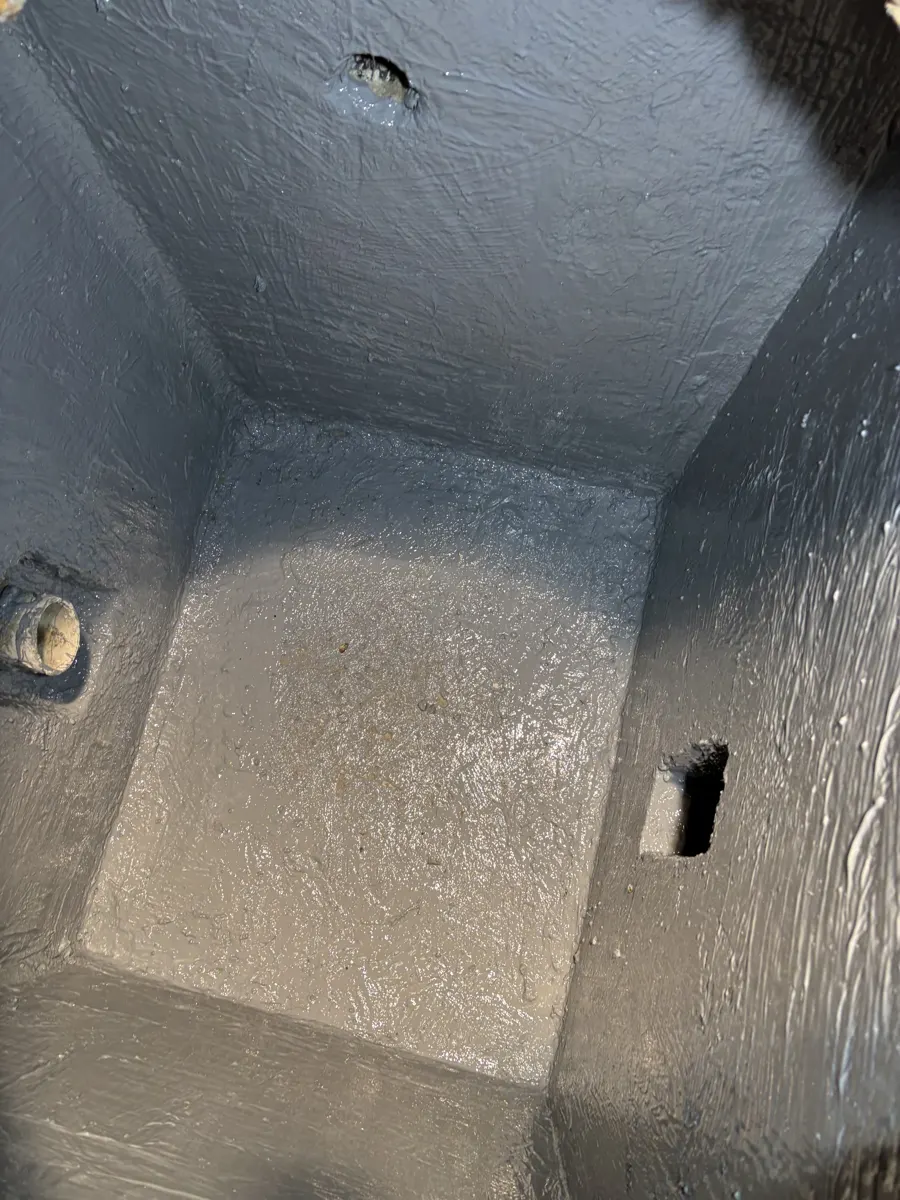
A repaired trap is guaranteed to pass inspection, backed by high industrial-grade materials, a repair back to the original specifications and coordination with the city inspectors. The guarantee speaks to the state of the trap we fixed; keeping Austin’s cleaning schedule and your hauler’s manifests is still your side of an inspection. On top of that, you get a 10-year warranty on labor and materials, as long as the trap gets regular pump-outs. Our page on grease trap repair in Austin has the details.
Repair, replacement, or the City’s program
We don’t publish prices, since two things set the cost: how big the trap is and how much damage it has. Set against a new trap your business buys and installs itself, repair typically comes to under half the cost of replacement. Some traps are past saving or too small for the kitchen, and then a new one is the right call; our grease trap replacement guide for Austin lays out what to check.
If replacement is on the table, the City’s Grease Trap Relief Program is worth a look before you buy.
From October 1, 2026, qualifying and approved businesses can receive no-cost grease trap equipment and installation or replacement through the program. It takes an application, and Austin Water says “Submission does not guarantee approval.” The traps it installs are poly/fiberglass models fitted with a monitoring system, and the business pays an annual monitoring service fee, which the City says is “essentially offset by the Utility Compliance Services Division waiving the annual Wastewater Discharge Permit Fee”. After installation, the City’s terms state that “all future maintenance and repair costs are the responsibility of the food establishment or property owner.”
More questions about how grease traps work
Does a grease trap need to be vented?
Yes, in one form or another. A vent or air-relief path lets air into the space above the water so the trap doesn’t siphon itself or build back-pressure. On compact indoor units, Austin Water also requires a vented flow control device upstream of the unit.
Is a trap that was just emptied working properly?
Not on its own. The standard for compact interceptors tells whoever cleans the unit to check afterwards that the inlet, outlet and air-relief ports are clear. A trap can be empty and still have a blocked port or a missing part.
Who is allowed to empty a grease trap in Austin?
A liquid waste hauler licensed by the Texas Commission on Environmental Quality and permitted by the City of Austin. Austin Water’s FAQ says the trap must be “completely emptied and cleaned by a permitted liquid waste hauler”. That’s your pumping company, not a repair company.
Sources
- Austin City Code, § 15-10-197, Requirements for cleaning grease traps (Municode)
- Austin Water, Pretreatment Requirements and Resources FAQ
- Austin Water, Grease Trap Maintenance
- Austin Water, Grease Trap Sizing and Design Criteria
- Austin Water, Grease Trap Relief Program
- U.S. EPA, National Pretreatment Program fact sheet on food service establishments
- U.S. EPA, Fats, Oils and Grease training slides for operators, and Hydrogen Sulfide Corrosion in Wastewater Collection and Treatment Systems, Report to Congress
- Plumbing and Drainage Institute, standard PDI-G101 for hydromechanical grease interceptors
- City of Bellevue, WA Utilities, Fats, Oils and Grease: How the System Works
Updated October 2026
Not sure whether your trap is full or broken?
When the manifest notes damage, or the trap keeps misbehaving right after a pump-out, get it checked while there’s still time before an inspector sees it. Call (512) 801-4131 at any hour: the line is open 24/7, and someone picks up at night to book your free inspection. Prefer writing? Use our contact page.