Grease Trap Baffle Wall: What It Does, Why It Breaks, What Fixes It
A grease trap baffle wall is the divider that splits the trap into two compartments. It holds most of the floating grease in the first compartment, away from the outlet pipe and the sewer. Once a baffle cracks through, corrodes into holes or falls apart, more grease and solids can slip past it to the outlet, and a trap in that state can fail inspection. A broken baffle on its own doesn’t mean you need a new trap: in most cases the wall can be rebuilt inside the trap you already have.
If your pumping company or an inspector has just told you the baffle is broken or missing, this post covers what they saw, what it means under Austin’s rules, and what a repair involves. For the wider list of warning signs, see the signs of grease trap damage in Austin.
What is a baffle in a grease trap?
Grease is lighter than water, so it floats. Food solids are heavier, so they sink. A grease trap gives both of them time to separate before the water leaves, and the baffle wall is what makes that work.
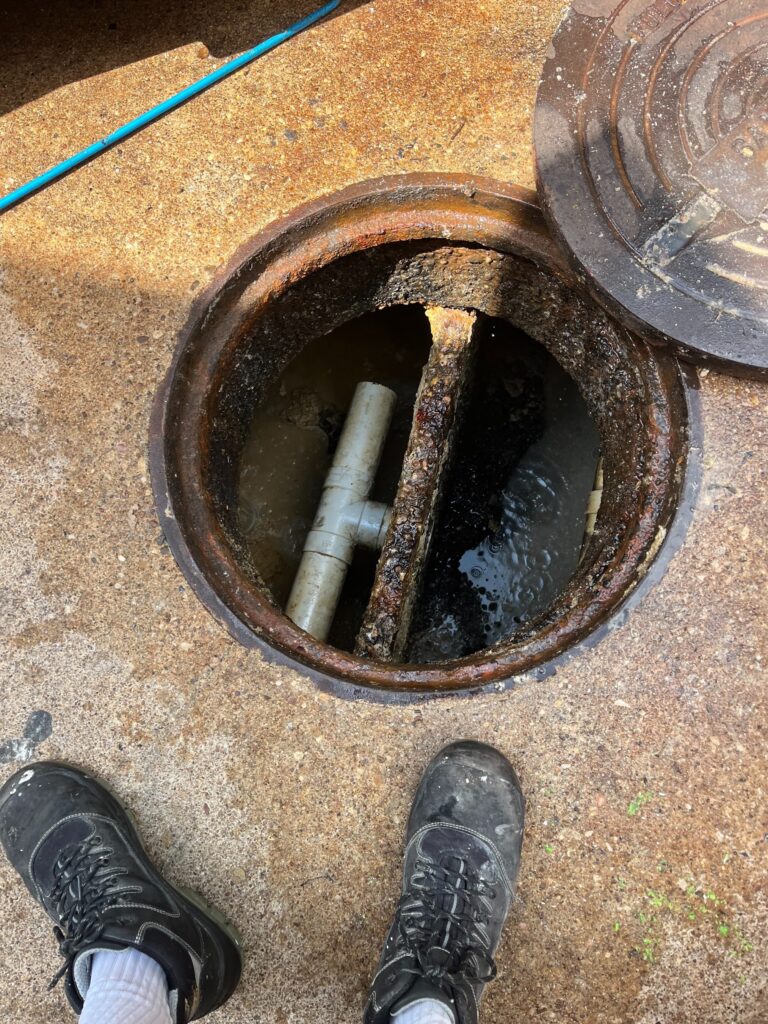
Wastewater from your sinks enters the first compartment through the inlet pipe. The baffle stands across the tank between that compartment and the second one. Its top sits above the water, and the water moves on to the second compartment through the space low down, beneath the floating layer. Because grease floats, it generally won’t travel down and under the baffle, so it builds up on the inlet side. The cleaner water then leaves through the outlet pipe toward the sewer.
Austin Water describes the typical grease trap as a large pre-cast concrete tank of 250 to 10,000 gallons, “with two compartments that allow separation and retention time.” Retention time is how long the water stays in the tank. The baffle wall is the divider that creates those two compartments.
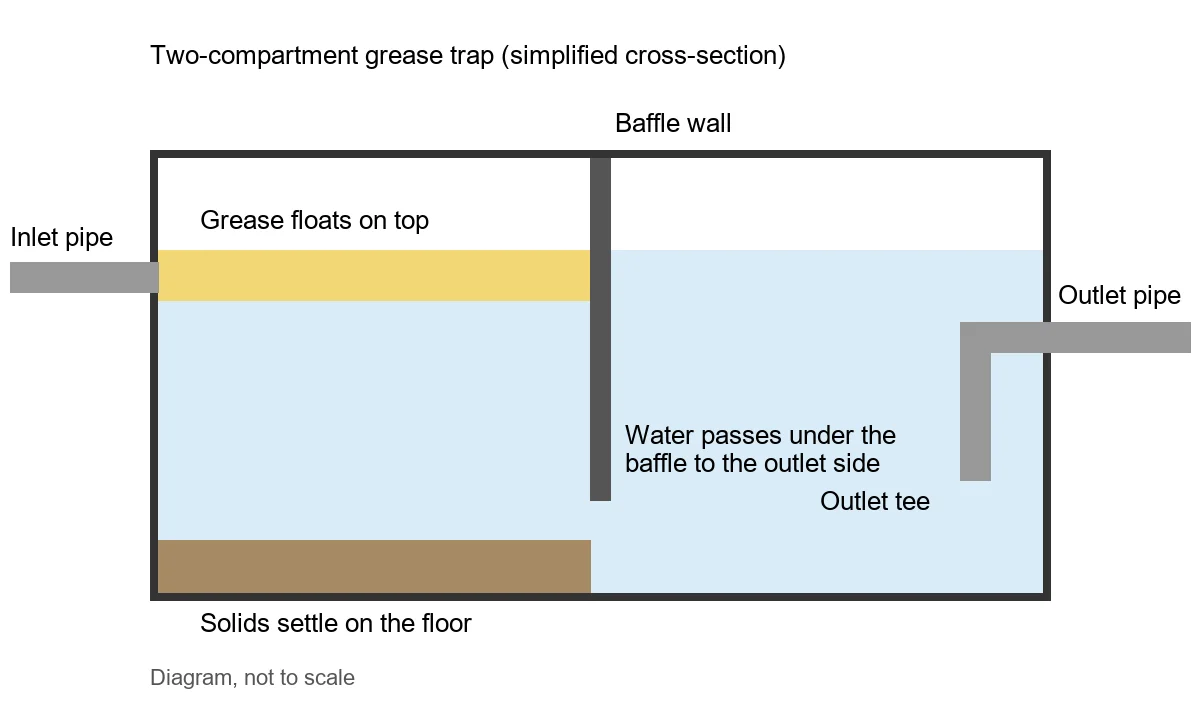
Grease trap baffle diagram
The drawing below is a simplified cross-section. Reading it from left to right:
- Inlet pipe. Brings the kitchen’s wastewater into the first compartment.
- Grease layer. Floats on the surface of the first compartment.
- Solids. Settle on the floor of the tank.
- Baffle wall. Holds the grease layer back, while water passes under it into the second compartment.
- Outlet tee. A fitting on the outlet pipe whose leg reaches down into the water, so what leaves is drawn from below any floating grease.
- Outlet pipe. Carries the water out to the sewer.
Is a grease interceptor baffle the same thing?
Yes, the job is the same, though the hardware varies. “Grease trap” and “grease interceptor” are often used for the same thing. The large in-ground tank Austin Water calls typical is a gravity interceptor: it relies on grease floating and solids sinking, and it needs a long retention time, which is why tanks like it are big and buried outside.
In a large interceptor, the divider may be a full wall or a fitting that reaches down into the water, below the floating grease. Factory-made traps use baffles too, and Austin Water notes these may be made of thermoplastic, fiberglass, polyethylene or stainless steel. The compact units installed inside a building are called hydromechanical interceptors.
Whatever the size, once the divider is missing or failed, little holds the grease back from the outlet.
Why do concrete grease trap baffles break?
A concrete baffle breaks for the same reason concrete tank walls do: acid.
Grease and food waste that sit in a trap give off hydrogen sulfide gas. On damp surfaces above the water, bacteria turn that gas into sulfuric acid, and the acid eats the cement and limestone in concrete, leaving soft material behind. A baffle wall is exposed to that air on both faces, so it can lose concrete from two sides at once. That’s our reading of how the chemistry applies to a baffle, not a finding written about baffles by name.
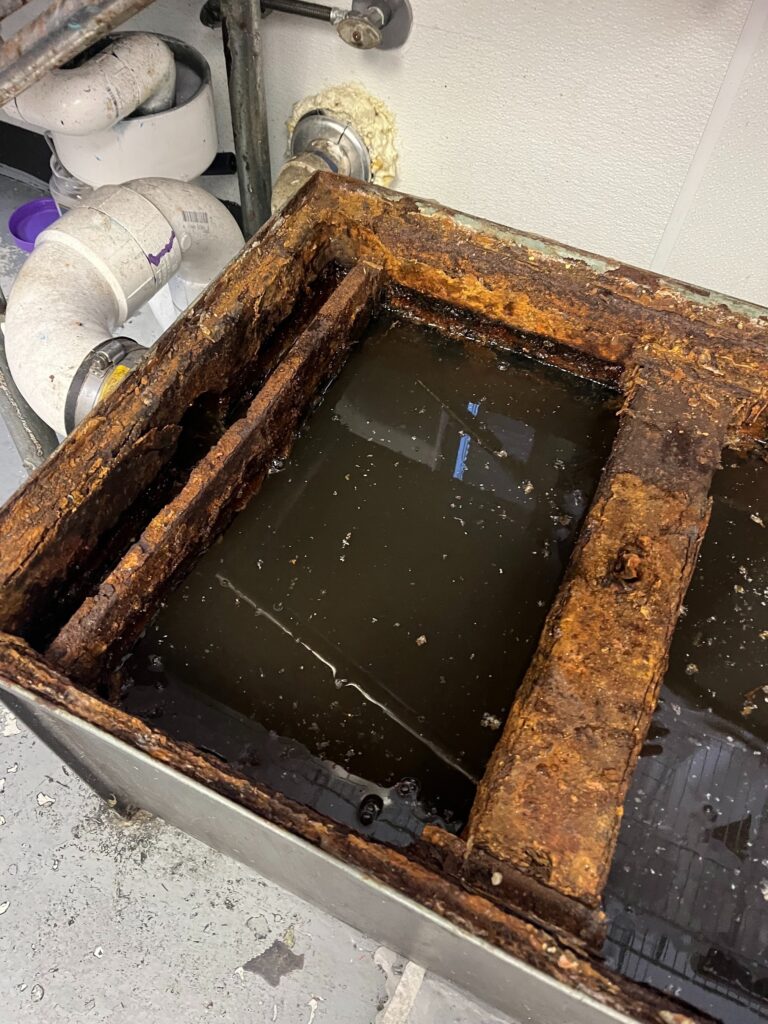
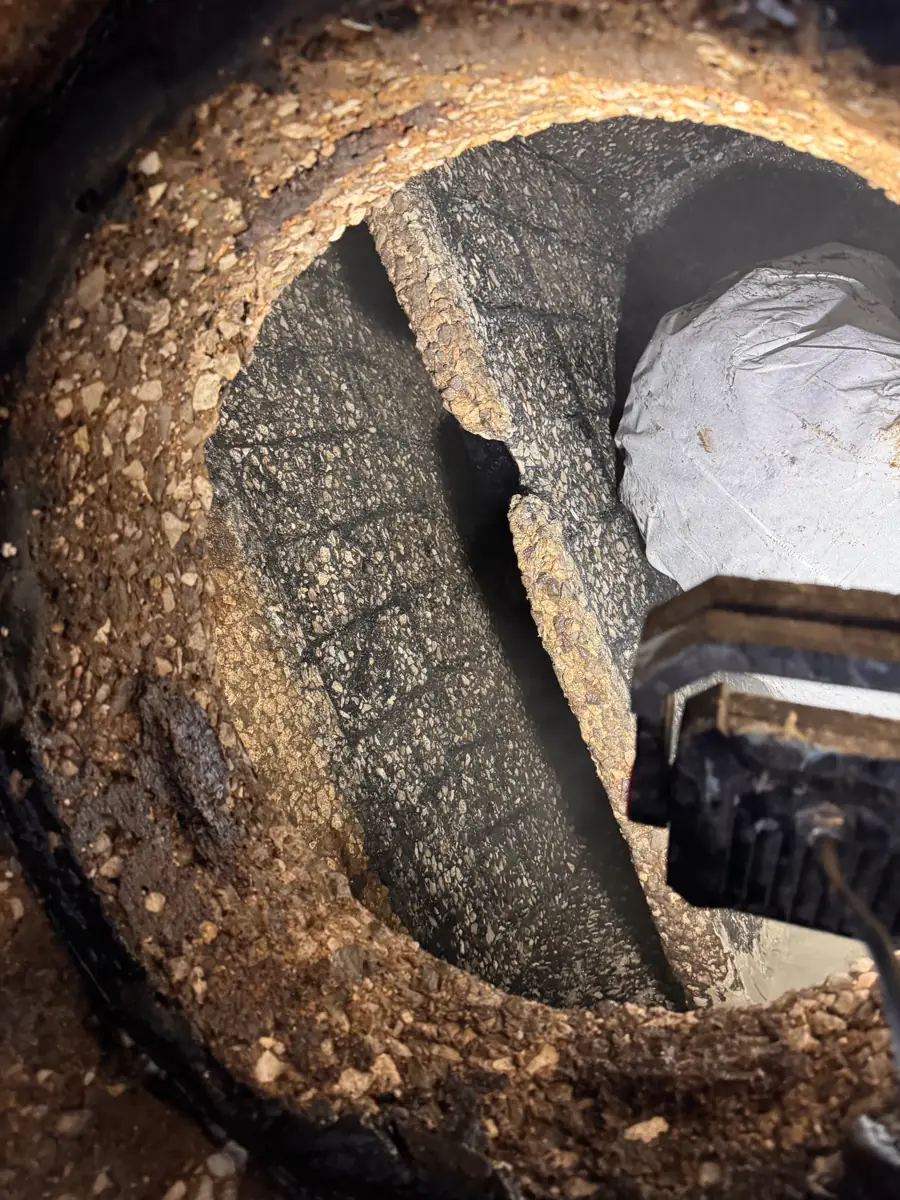
What that can look like inside an emptied trap:
- A band of soft, crumbling concrete on the baffle above the waterline.
- Holes eaten through the wall, letting grease pass straight through it.
- A baffle thinned until sections have broken off and dropped to the floor of the tank.
- On steel traps, a baffle rusted through, because the gas attacks steel directly.
In our reading of the EPA’s work on sewer corrosion, the longer waste sits between pump-outs, the more time this process has. For how the same corrosion shows up as water escaping the trap, see why grease traps leak and where.
How do you know if a grease trap baffle is broken?
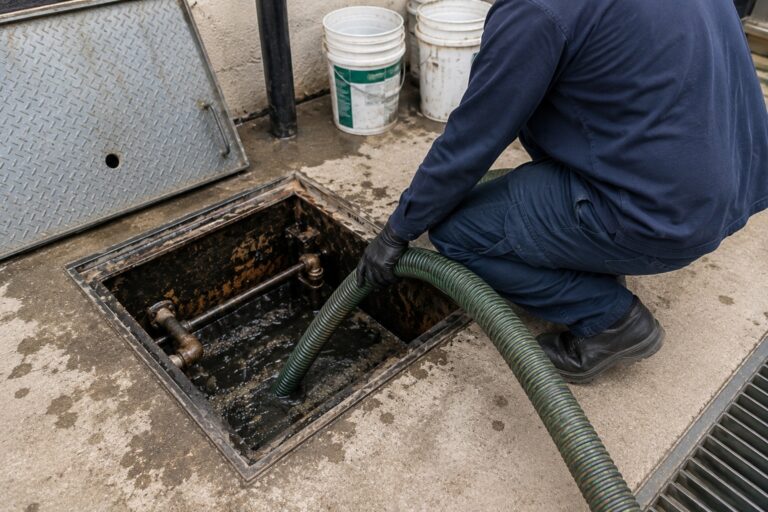
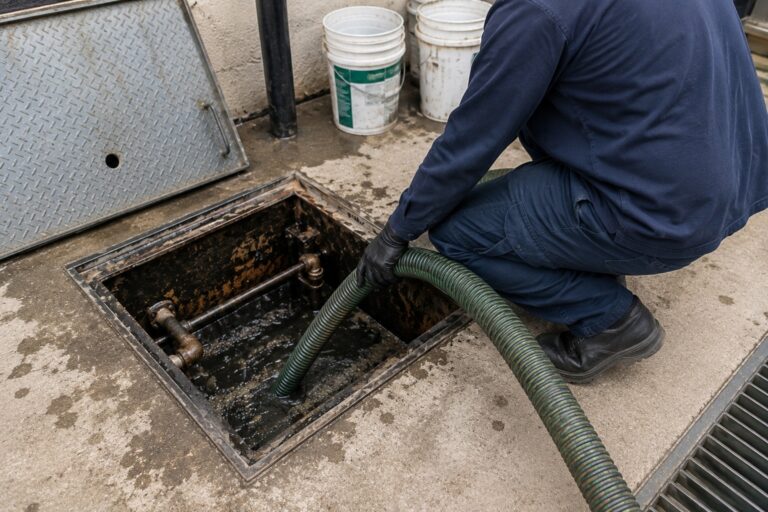
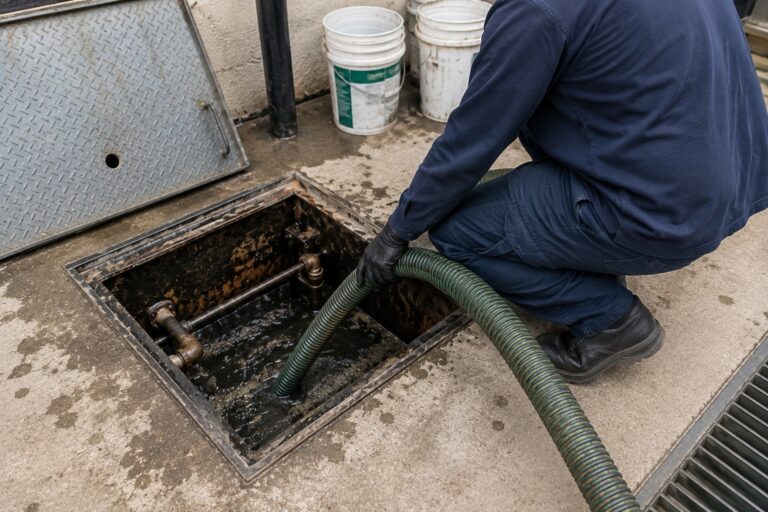
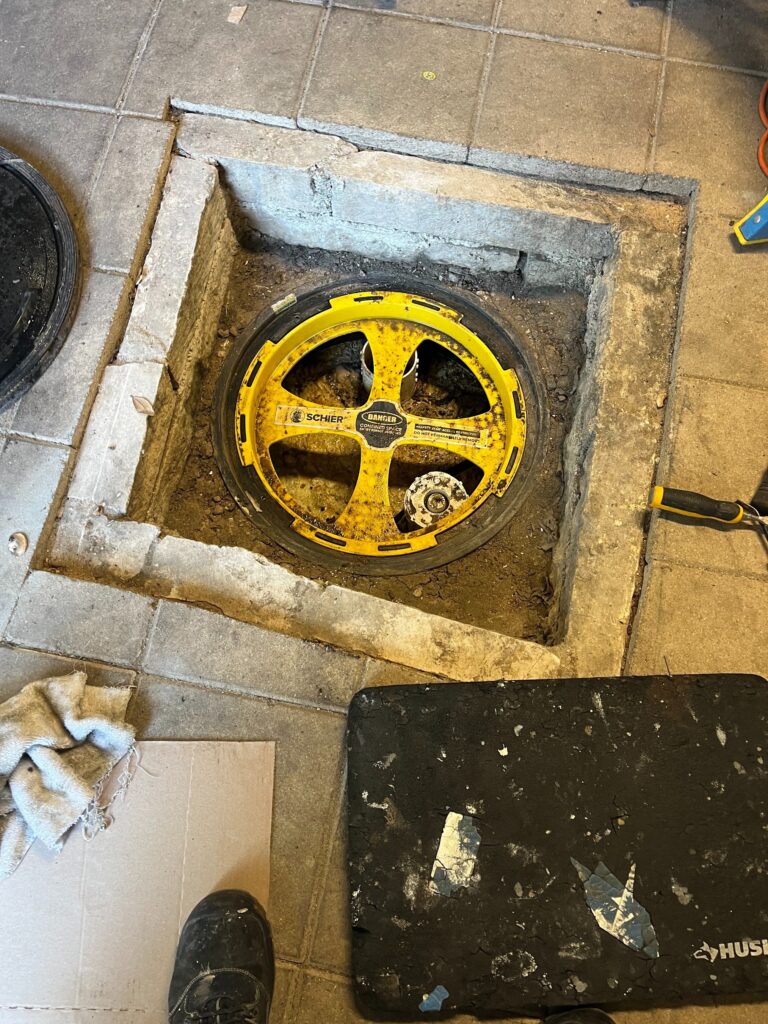
From the kitchen, you usually can’t. The baffle is below a heavy lid, in a space that can hold hydrogen sulfide and other dangerous gases, so don’t open the trap to look. The people who see the baffle are the ones standing over the open tank: your pumping company at each pump-out, and anyone inspecting the trap while it’s open.
What your pumper or inspector sees
With the tank emptied, a cracked, holed or collapsed baffle is in plain view. Your hauler can flag it on the manifest, the service record you get after each pump-out. Austin Water is direct about what comes next:
“If a pump-out manifest provided to you by the LWH indicates that the GT needs repair, take appropriate action to have it serviced immediately.”
— Austin Water, Grease Trap Maintenance (the LWH is your liquid waste hauler, and GT stands for grease trap)
Broken baffle or just a full trap?
Every sign in this table needs the trap open, so it comes from what your hauler or an inspector reports, not from looking yourself.
| More likely a full trap | More likely a broken baffle |
|---|---|
| The last pump-out was a while ago | The trap was pumped recently and still struggles |
| Your hauler reports thick grease in the first compartment and less in the second | Your hauler reports about as much floating grease in the second compartment as in the first |
| Things improve after a pump-out and stay better | Your hauler or inspector finds grease at the outlet end soon after a pump-out |
If the trap is simply full, your pumping company is the right call. Emptying the trap is their job, not ours. If the trap is emptied on schedule and grease still reaches the outlet side, the wall meant to stop it may no longer be doing so.
One caution: grease in the sewer line doesn’t always mean the trap is broken. The U.S. EPA’s training slides for operators describe one case: a trap pumped every two months, with its baffle wall and inlet and outlet tees in proper order, that still had heavy grease downstream. The next step there was a dye test of the kitchen’s fixtures. If a drain bypasses the trap, a rebuilt baffle won’t fix grease that never goes through it.
Will a broken baffle fail an Austin grease trap inspection?
It’s likely to, because the trap can no longer do the job Austin’s code requires of it. Every commercial food business must “construct, operate, and maintain a pretreatment facility approved by the director” (§ 15-10-71), and for a restaurant that facility is the grease trap.
Austin also sets a cleaning rule. The trap has to be cleaned at least every three months, or sooner once grease and solids reach 50% of its wetted height, “as measured from the bottom of the grease trap to the invert of the outlet pipe” (§ 15-10-197). The invert is the lowest inside edge of the outlet pipe. Keeping to that schedule protects the trap, but it can’t make up for a baffle that’s gone. Pumping empties the trap. It doesn’t put the wall back.
The chapter also carries money penalties. If a person has received actual notice of the chapter’s provisions and acts in violation of it or fails to take action to comply, the City can sue for civil penalties of up to $5,000 a day for each violation (§ 15-10-252).
If an inspection has already gone against you, read what to do after a failed grease trap inspection.
Can a grease trap baffle wall be repaired, or does it need replacing?
A broken baffle wall can usually be rebuilt in the existing trap, and that’s work we do. We repair baffle walls in cast concrete, steel and fiberglass traps of all sizes, underground or above ground.
- A free on-site inspection. A technician checks the baffle and the rest of the trap: the walls, the floor and the T-pipes share the tank with it, so they’re looked at too.
- Your pumping company empties the trap before the work starts.
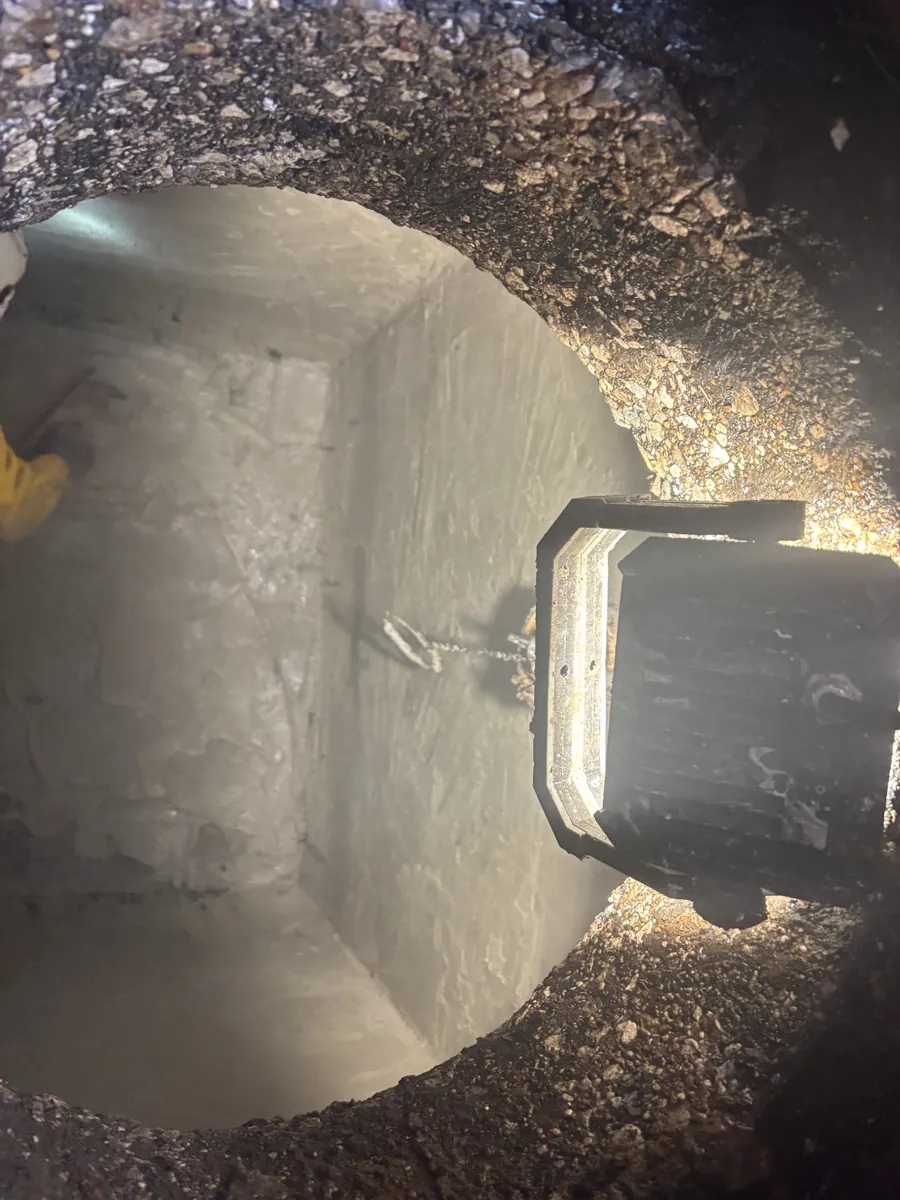
- Overnight, after you close. The trap is cleaned and degreased, holes and cracks are repaired, the broken baffle wall is rebuilt, and the whole trap is coated. The method is called coating; lining and relining mean the same thing.
- Ready the next morning, so the kitchen keeps running.
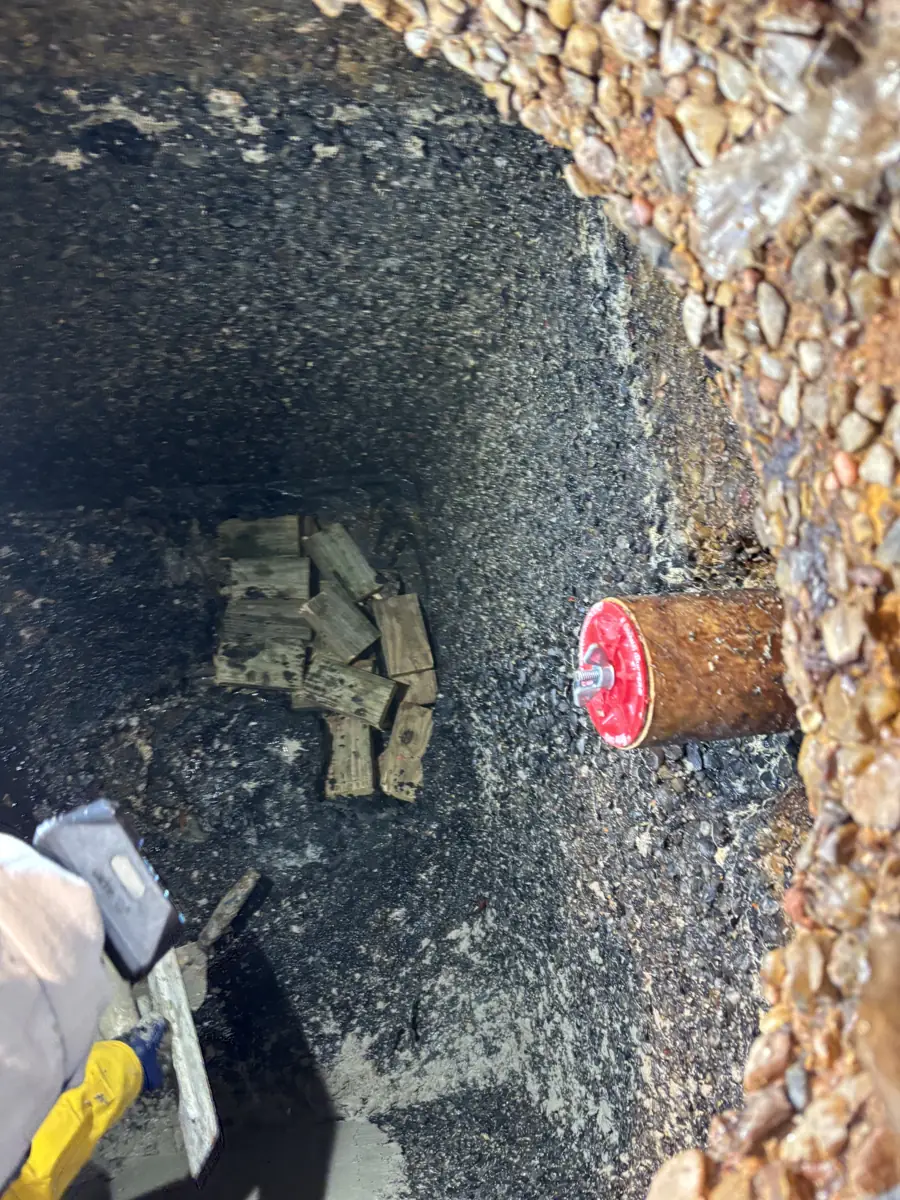
The repaired trap is guaranteed to pass inspection: we repair with high industrial-grade materials, back to the original specifications, and coordinate with the city inspectors on any inspection needed. That promise is about the condition of the trap we repaired. Regular pump-outs on Austin’s schedule and your hauler’s paperwork remain your side of passing. Every repair carries a 10-year warranty on labor and materials, as long as the trap gets regular pump-outs. You can read more about how grease trap repair works in Austin.
Grease trap baffle replacement cost
We don’t publish prices, because no two jobs are the same. The price depends on the size of the trap and the amount of damage. Compared with a new trap you buy and install at your own cost, a repair that includes a rebuilt baffle typically comes in under half as much. The free inspection is where you get the actual number for your trap.
When the whole trap should be replaced
Sometimes a new trap is the better answer: the tank is too far gone to save, or it’s too small for the kitchen it now serves. We install new traps too. In Austin, a new trap needs building plan approval and an Industrial Waste approval letter specifying its size and design before it’s bought. If you’re weighing that route, read what to check before you replace a grease trap in Austin.
Before paying for a new trap, look at the City’s Grease Trap Relief Program. Beginning October 1, 2026, it offers qualifying and approved businesses no-cost grease trap equipment and installation or replacement, with small, locally owned businesses and charitable feeding organizations named as the primary beneficiaries. You apply, and submitting doesn’t guarantee approval. The City says the traps it installs carry a warranty; repair costs that warranty doesn’t cover belong to the business, which owns the new trap. If you’re selected, the City pays for the new trap and its installation, and no repair price competes with that. The business pays an annual monitoring fee, which Austin Water says is “essentially offset” by waiving the annual Wastewater Discharge Permit Fee.
More questions about grease trap baffles
Is a missing outlet T-pipe the same problem?
It’s a separate part with a related job. The baffle holds the grease layer back inside the tank; the outlet tee reaches down into the water so that what leaves the trap is drawn from below that layer. If the tee is missing or corroded through, grease can reach the sewer even past a sound baffle. We repair T-pipes, and the free inspection checks them along with the baffle.
Is a baffle the same as the sample well?
No. The baffle sits inside the tank and divides it. A sample well, which some traps have, is a separate small chamber at the outlet end, used to take a sample of the water leaving the trap.
Sources
- Austin City Code, § 15-10-197, Requirements for cleaning grease traps (Municode)
- Austin Water, Grease Trap Maintenance
- Austin Water, Grease Trap Relief Program
- Austin Water, Pretreatment Requirements and Resources FAQ
- City of Bellevue, WA Utilities, Fats, Oils and Grease: How the System Works
- U.S. EPA, Fats, Oils and Grease training slides for operators (NPDES Operator Webinar, October 2023), and Hydrogen Sulfide Corrosion in Wastewater Collection and Treatment Systems, Report to Congress
Sources last checked October 2026
Updated October 2026
Was your baffle flagged at the last pump-out?
If your hauler’s manifest or an inspector says the baffle is broken, have the trap looked at before the next inspection. Call (512) 801-4131. We’re open 24/7, and a person answers at any hour and books your free inspection. You can also reach us through the contact page, or start from the Grease Trap Repair Austin home page.