Why Is My Grease Trap Leaking? Causes, Signs and Fixes
Why is my grease trap leaking? A grease trap can leak where a lid, cover or gasket no longer seals, at the seam of an older two-piece trap, or through a hole or crack in its walls, floor or pipe fittings. Those holes and cracks can come from the trap’s own contents: as grease and food waste break down, they give off a gas and an acid that eat concrete and corrode steel. A leak through the body of the trap is damage, and most damaged traps can be repaired without replacing them.
One thing first: water rising up out of the lid, the sinks or the floor drains points to an overflow, not a leak. An overflow comes from a full trap or a blocked line, and the next section shows how to tell the two apart.
Is my grease trap leaking, or is it overflowing?
The two can look alike from the kitchen floor, but they have different causes and different fixes.
| Signs of an overflow | Signs of a leak |
|---|---|
| Water or grease backs up through the sinks, the floor drains or the lid | Water or damp at the side of the trap, at a gasket or around a pipe |
| Drains run slowly or gurgle, or there’s a rotten-egg smell near the trap | Your hauler finds the water level lower than it should be when nothing is draining |
| The trap is due or overdue for its pump-out | You can see cracks, holes, rust or soft spots in the trap |
An overflow means water can’t get through the trap fast enough. In Austin, the trap has to be cleaned at least every three months, and sooner once grease and solids fill 50% of its wetted height. That height is measured from the bottom of the trap to the invert of the outlet pipe, which is the lowest inside edge of the pipe the water leaves through (§ 15-10-197).
If your trap is full, call your pumping company. We don’t pump traps. If the pumping is up to date and the line past the trap is backed up, that’s a plumber’s job. A trap that backs up again soon after a pump-out may have a fault inside it: EPA’s training slides on fats, oils and grease list a missing inlet T-pipe, the T-shaped fitting that turns incoming water downward, as a fault that makes backups in the kitchen more likely. That’s worth having looked at.
For warning signs beyond leaks and overflows, see our post on the signs of grease trap damage.
Why is my grease trap leaking from the lid or top?
Rule out an overflow first. If the trap isn’t full and water still collects at the top, look at what the lid sits on and how it closes.
A lid or cover that no longer seals
Lids and covers that no longer seal, and gaskets that leak, are read as damage rather than a missed pump-out. Austin Water’s own access check for kitchens is a good habit here too: make sure “that lids aren’t blocked, bolts aren’t seized, and covers aren’t damaged.”
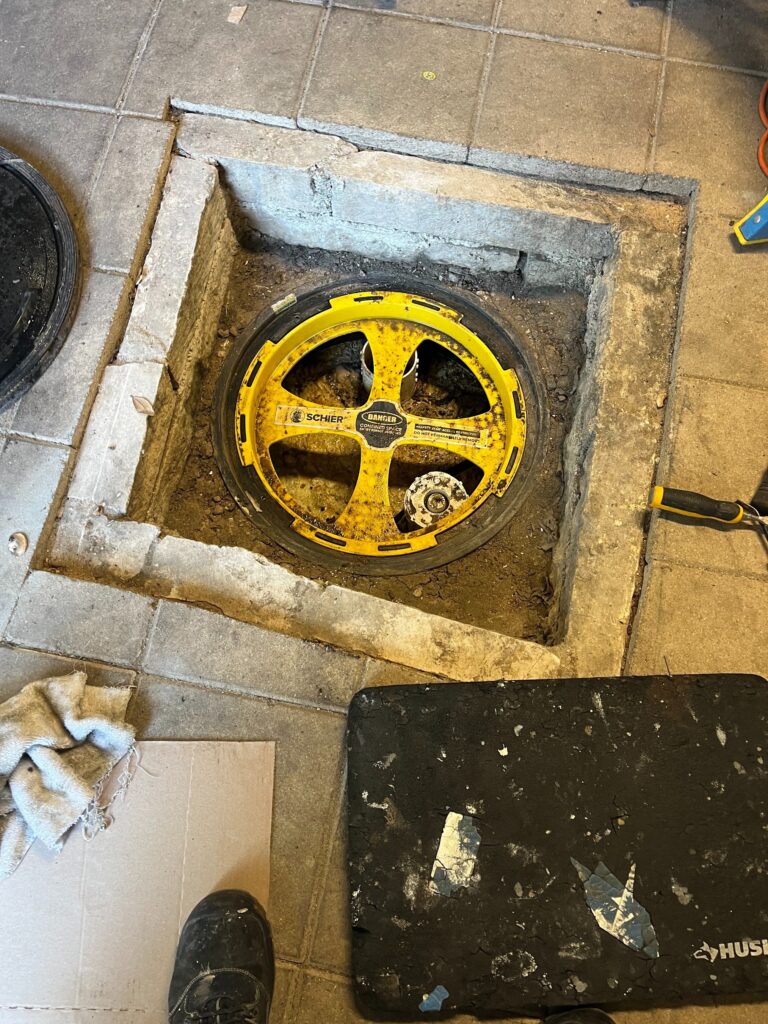
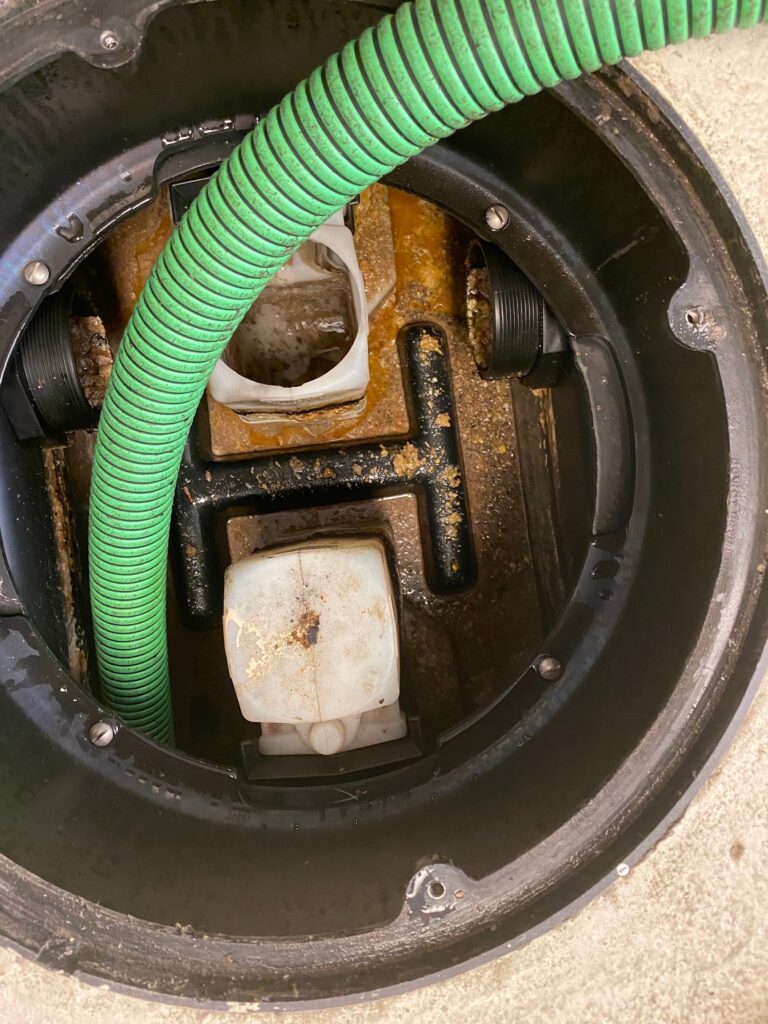
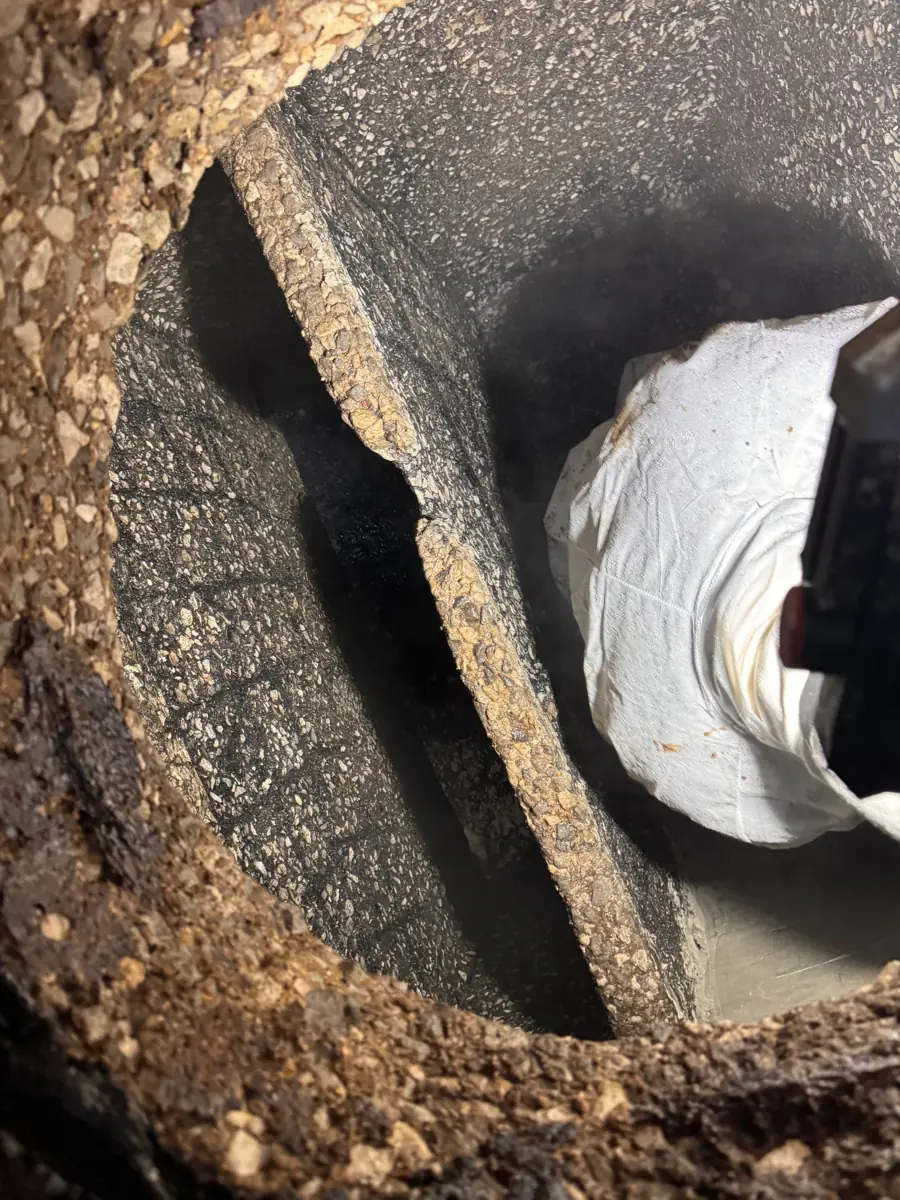
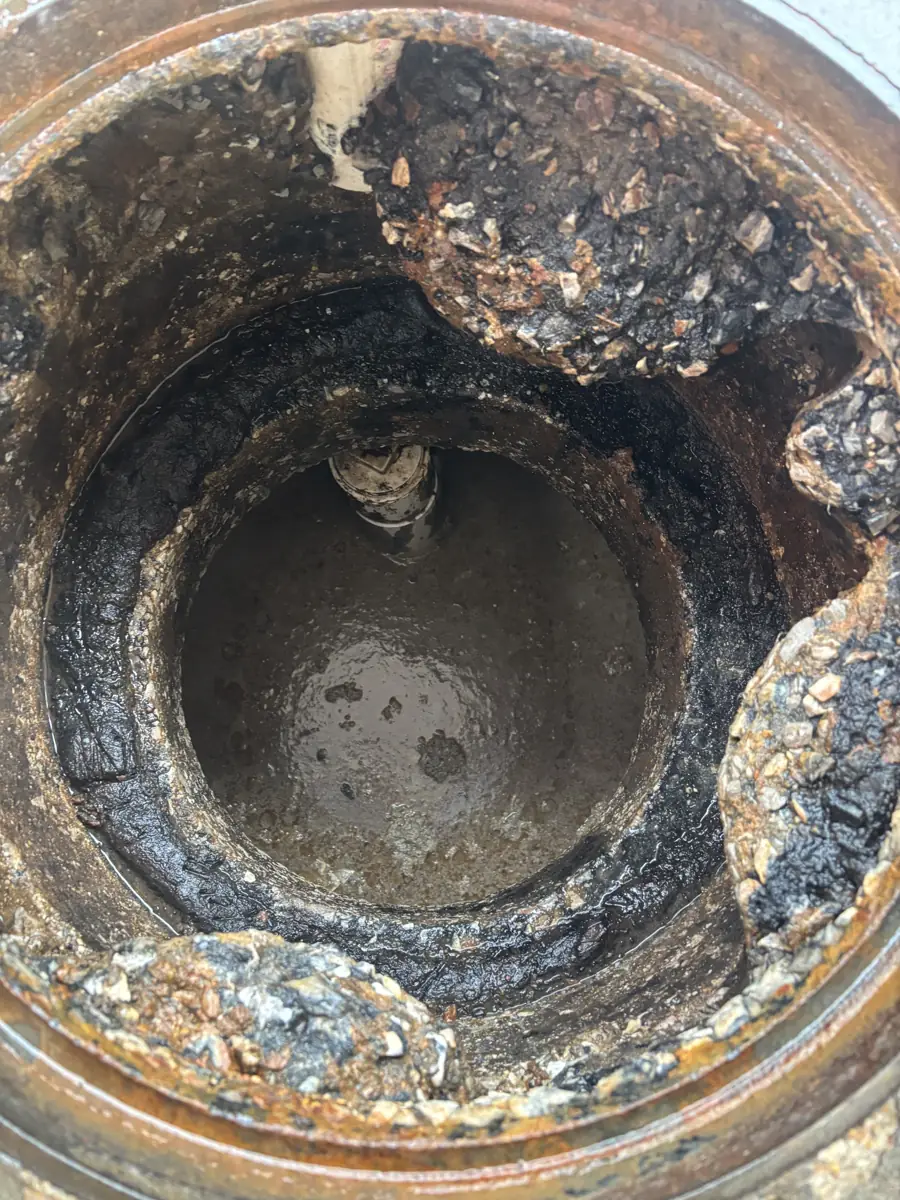
On an in-ground trap, the lid can sit on a riser, the concrete neck around the opening, as in the photo below. A riser sits above the water, which is where EPA says the acid forms, so it can crumble the same way the trap’s upper walls do. A lid can’t seal on crumbling concrete.
The seam on an older two-piece trap
Some older traps were built in two pieces, a tank body with a separate top, rather than as one piece. EPA’s training slides show one of these leaking at the seam where the two pieces meet.
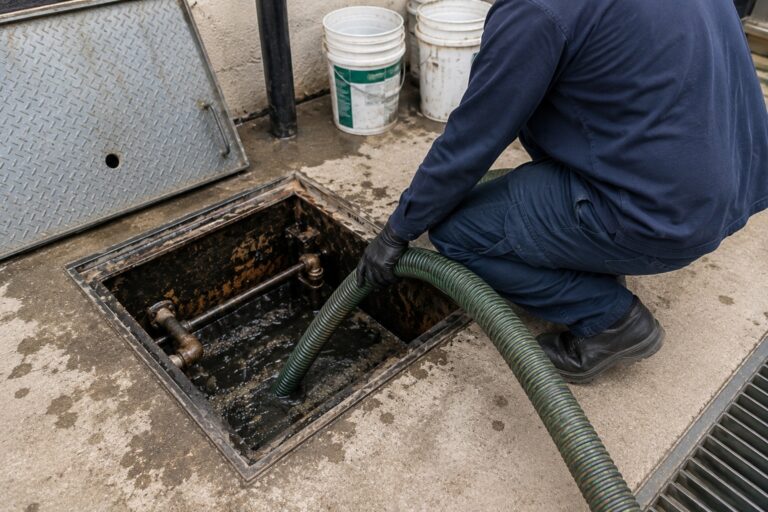
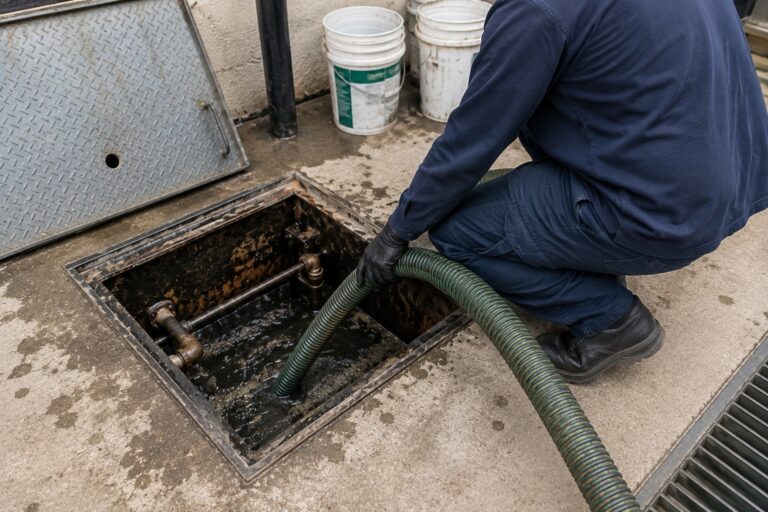
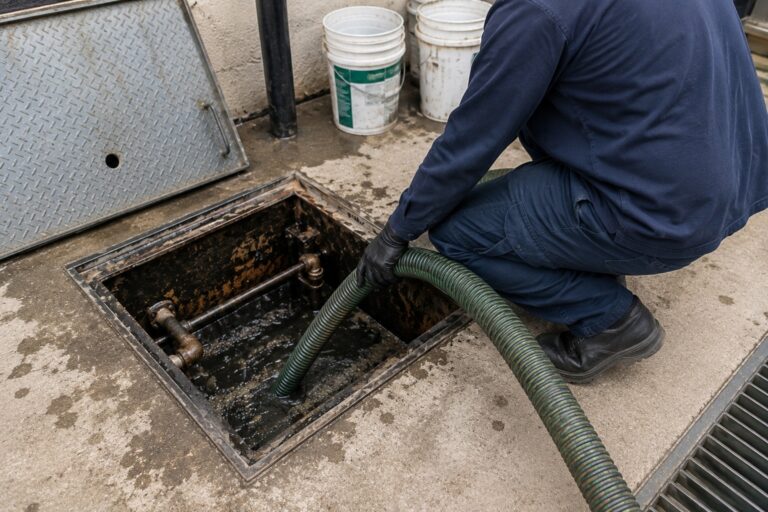
Don’t lift the lid to look for the cause yourself. A grease trap opening is a confined space that can hold dangerous gases, including hydrogen sulfide. Austin Water’s advice is to be present for pump-outs and talk to your hauler about the condition of the trap, which is the safe time to see inside it. Mention a lid that won’t seal when you book a free inspection, and the technician will tell you what it needs.
Why is my grease trap leaking water at the pipes or walls?
Around the inlet and outlet pipes
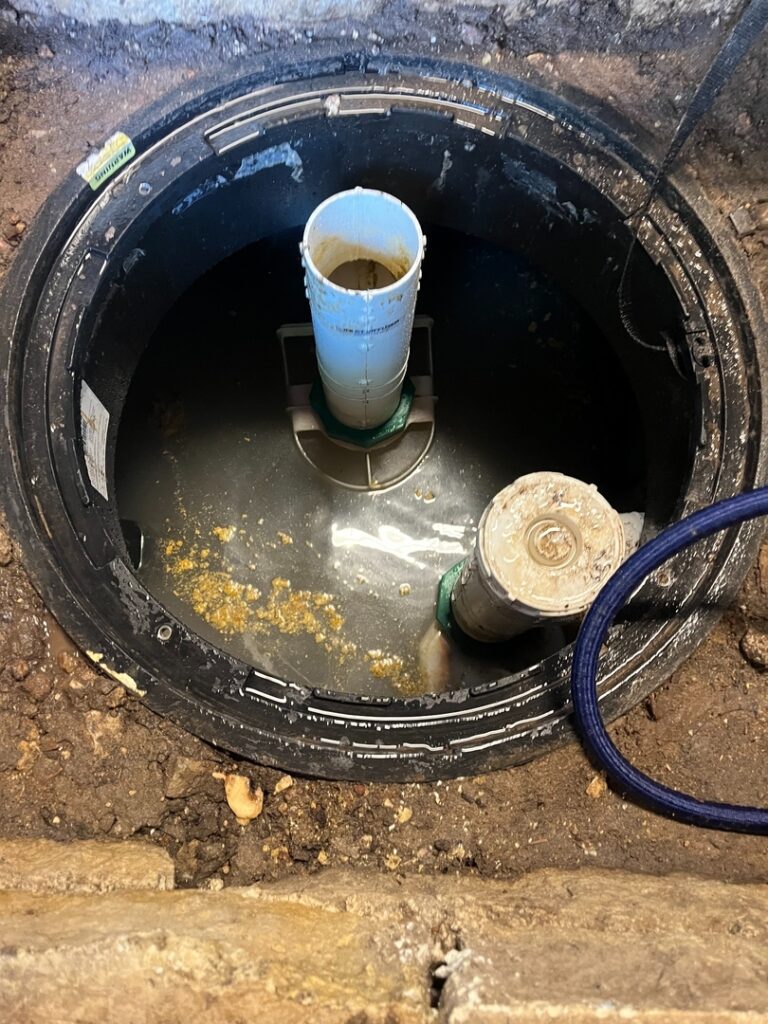
The inlet pipe brings kitchen wastewater into the trap, and the outlet pipe sends the separated water on to the sewer. On the inlet, the T-pipe turns the incoming flow downward so it doesn’t stir up grease that has already floated to the top. The pipes and their fittings sit in the same gas as the rest of the trap, and EPA describes hydrogen sulfide attacking iron and steel directly. Damp around a pipe where it meets the trap is worth mentioning when you book an inspection.
Through the walls
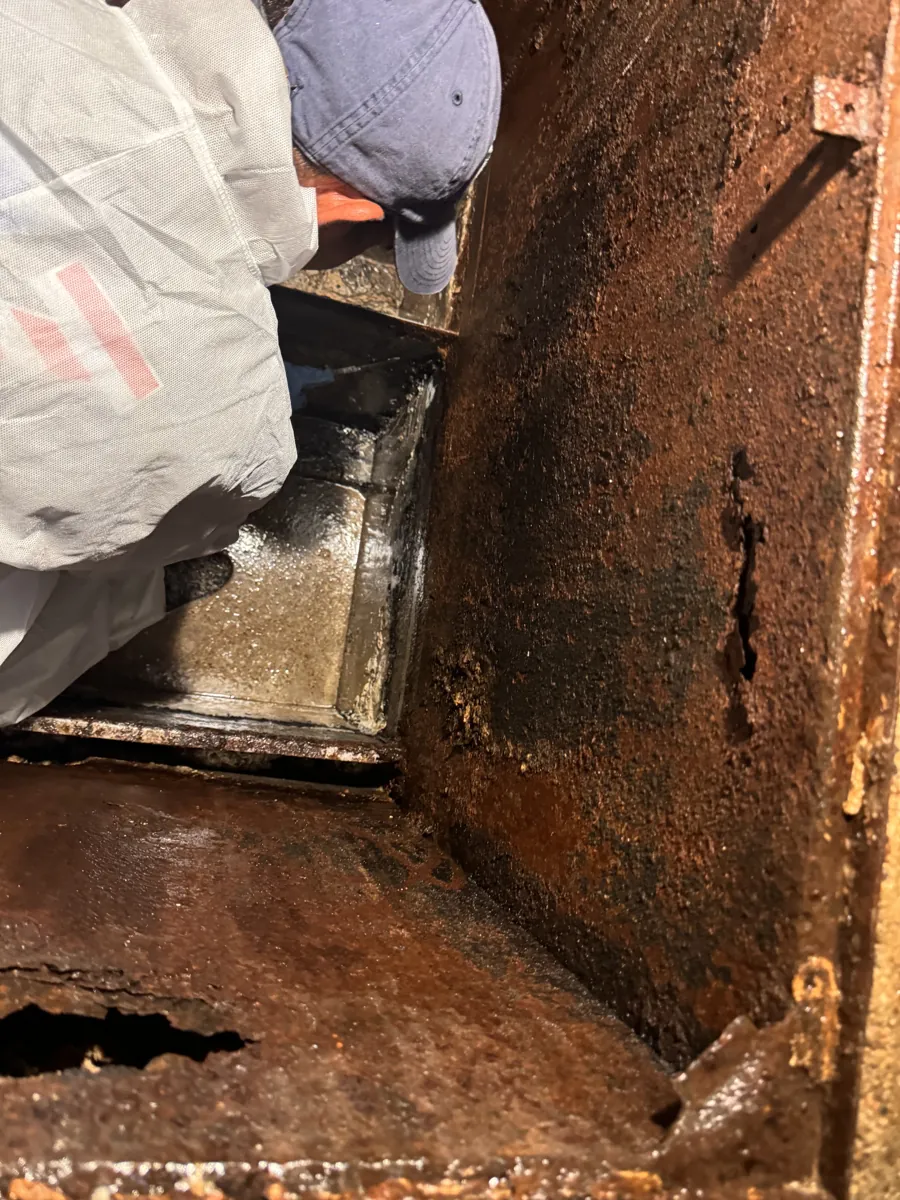
Wall damage starts on the inside, above the water, so it’s out of sight until it goes through (the corrosion section below explains why). In a steel trap, the gas attacks the metal itself. Once rust opens holes in a wall, water that should leave through the outlet escapes through the wall instead. The photo below shows a steel wall rusted through along its bottom edge. A concrete wall gets there by a different route: the acid softens it until it cracks or holes.
We repair inlet and outlet pipes, T-pipes, and holes and cracks in the walls and floor, in cast concrete, steel and fiberglass traps of all sizes, underground or above ground.
Why is my grease trap leaking from the bottom?
What a leak from the bottom looks like depends on where the trap sits.
A trap under the sink or above ground
With a smaller trap under a sink or on the floor, a leak from the bottom shows up as a drip or a puddle under the unit. On a steel unit, it can be the same rust shown above, low on the tank.
An in-ground trap
You can’t see the bottom of an in-ground trap, so the clue comes from your hauler at the pump-out. A water level that sits lower than it should while nothing has been draining points to a leaking tank rather than a full one. Ask your hauler to note it on the manifest. Austin Water describes the typical grease trap as a large pre-cast concrete tank, and a crack in the floor or lower walls is one way water gets out of a tank like that.
Cracks in a trap’s floor and walls are repair work. A crack being low down doesn’t by itself mean you need a new tank.
What causes grease trap corrosion?
Fats, oils and grease carry weak acids of their own, which EPA notes can have a corrosion effect. The stronger attack comes from what happens as grease and food waste break down in the trap:
- The decaying waste produces hydrogen sulfide, a gas that dissolves in the water and then escapes into the air space above it. Warmer water releases more of it.
- Bacteria living on the damp surfaces above the waterline turn that gas into sulfuric acid.
- The acid eats the cement and limestone in the concrete, leaving soft material such as gypsum behind. Steel and iron parts are attacked by the gas directly.
Time is what lets this run. EPA names long detention times, meaning wastewater left sitting for a long time, among the conditions that increase hydrogen sulfide. In our reading, a trap left long past its pump-out date is that kind of condition. Because the acid forms above the water, inside the trap, a wall can be badly thinned before any water shows on the outside. Pumping on schedule cuts the time waste sits in the trap, but it doesn’t undo damage that’s already there.
What does Austin require when a grease trap is leaking?
Austin’s code makes the trap’s condition the business’s job, not only its pumping schedule. Every commercial food preparation business must “construct, operate, and maintain a pretreatment facility approved by the director” (§ 15-10-71). For a kitchen, that pretreatment facility is the grease trap.
Austin Water’s best management practices for kitchens name leaks directly: “Promptly address slow drains, backups, overflows, leaks, or other plumbing issues.”
Your hauler’s paperwork can flag a problem too. After each pump-out, the hauler gives you a manifest, the record of that service, which Austin requires you to keep for at least three years (§ 15-10-165). Austin Water says what to do when it flags a problem:
“If a pump-out manifest provided to you by the LWH indicates that the GT needs repair, take appropriate action to have it serviced immediately.”
— Austin Water, Grease Trap Maintenance (LWH means liquid waste hauler; GT means grease trap)
Chapter 15-10 as a whole is backed by civil penalties. If a person has received actual notice of the chapter’s provisions and acts in violation of it or fails to take action to comply, the City can sue for up to $5,000 a day for each violation, with each day counted separately (§ 15-10-252).
If an inspection has already gone against you, read what to do after a failed grease trap inspection in Austin.
How do you fix a leaking grease trap?
You find where the water gets out, then repair the damage. Most traps can be repaired, and how a grease trap repair is done comes down to four steps:
- A free on-site inspection. A technician looks at the trap and finds where it’s leaking. The price depends on the size of the trap and the amount of damage.
- Your pumping company empties the trap. It has to be empty before work starts.
- The repair, overnight. The trap is cleaned and degreased, holes and cracks are repaired, broken walls are rebuilt, and then the whole trap is coated. The method is called coating; you may also hear lining or relining.
- Ready the next morning. Your kitchen doesn’t have to close for it.
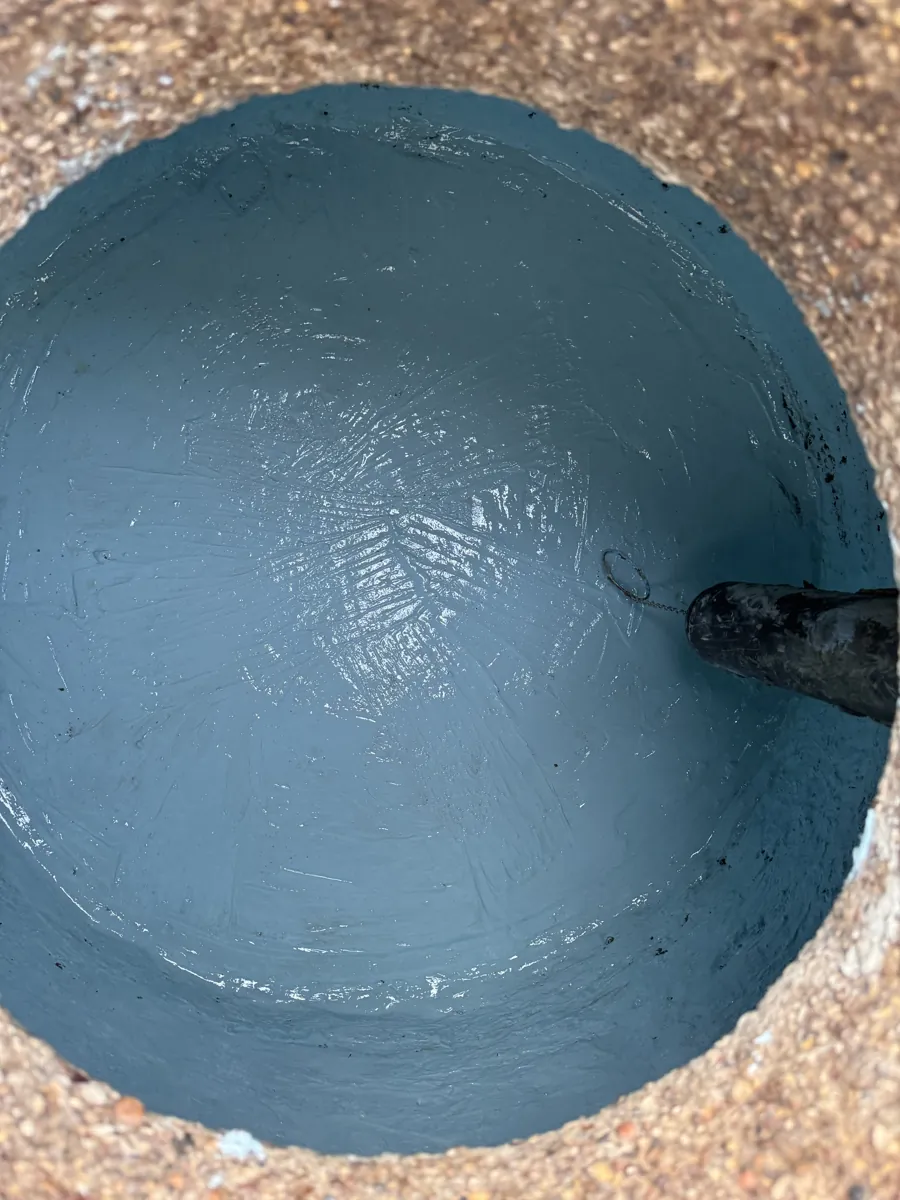
Against a replacement you pay for yourself, a repair typically costs under half as much. The repaired trap is guaranteed to pass inspection: we repair with high industrial-grade materials, back to the original specifications, and coordinate with the City’s inspectors on any inspection needed. The pump-out schedule and the manifests stay yours to keep up. Every repair also carries a 10-year warranty on labor and materials, as long as the trap gets regular pump-outs.
When is a new trap the better answer?
A trap that’s too damaged to save, or too small for the kitchen it now serves, needs replacing, and we install new traps too. In Austin, a new trap needs building plan approval and an Industrial Waste approval letter setting its size and design before it’s bought. If you’ve been told to replace yours, read this before you replace a grease trap.
Does Austin’s Grease Trap Relief Program cover replacement?
If replacement is on the table, check this program first. Since October 1, 2026, Austin Water’s Grease Trap Relief Program has offered qualifying and approved businesses no-cost grease trap equipment and installation or replacement. No facility is excluded from consideration, but small, locally owned businesses and charitable feeding organizations (CFOs) are named as the primary beneficiaries.
- You apply online. The documents include your menu, your FOG Best Management Practices, scalable drawings of the plumbing and kitchen equipment, and two years of hauler manifests; the program page lists everything required.
- Applying doesn’t guarantee approval. Applications that pass a completeness check are scored by a selection committee.
- Program traps are poly or fiberglass models with a monitoring system. The business pays an annual monitoring fee, which Austin Water says is “essentially offset” by waiving the annual Wastewater Discharge Permit Fee.
- The City says the process typically takes five to seven days.
If you’re selected, the City covers the cost of the new trap and its installation, and no repair price beats that. A repair makes sense if you don’t qualify, aren’t selected, are still waiting on an answer, or want to keep the trap you have and fix it overnight.
The same City page describes a separate rule. Since October 1, 2026, a new risk-based system decides whether a kitchen can get a variance from needing a grease trap at all, and some businesses with existing traps may not need to replace them. Any exemption depends on following FOG Best Management Practices. If the business later causes a sewer overflow by not following them, the exemption is revoked and a trap is required at its own expense.
Questions owners ask
Can I seal a leaking grease trap from the outside?
Not when the leak comes from corrosion. A patch on the outside doesn’t reach that damage. The acid forms on the inside surfaces of the trap, so that’s where the walls thin first, and that’s the surface a repair has to rebuild and coat.
Who pays if a trap installed through the Relief Program leaks later?
The City says installed traps carry a warranty, but “the business or CFO will be the owner of the new grease trap,” so repair costs the warranty doesn’t cover are the business’s. The City covers only the first installation or replacement.
Sources
- Austin Water, Grease Trap Maintenance
- Austin Water, Grease Trap Relief Program
- Austin City Code, § 15-10-197, Requirements for cleaning grease traps (Municode), with §§ 15-10-71, 15-10-165 and 15-10-252 in the same chapter
- Austin Water, Pretreatment Requirements and Resources FAQ
- U.S. EPA, Fats, Oils and Grease training slides
- U.S. EPA, Hydrogen Sulfide Corrosion in Wastewater Collection and Treatment Systems, Report to Congress
- Austin Water, Grease Trap Sizing and Design Criteria
- Bellevue, Washington Utilities, grease interceptor guidance (definition of the T-pipe)
- Sources last checked October 2026
Updated October 2026
Next step
If the trap isn’t overflowing and water still appears where it shouldn’t, have the trap looked at before the next inspection finds it. Call (512) 801-4131 or send us a message. We’re open 24/7, and a person answers and books a free inspection. You can also read more about grease trap repair in Austin.