Grease Trap Inlet and Outlet Pipes: What They Do and What to Do When One Fails
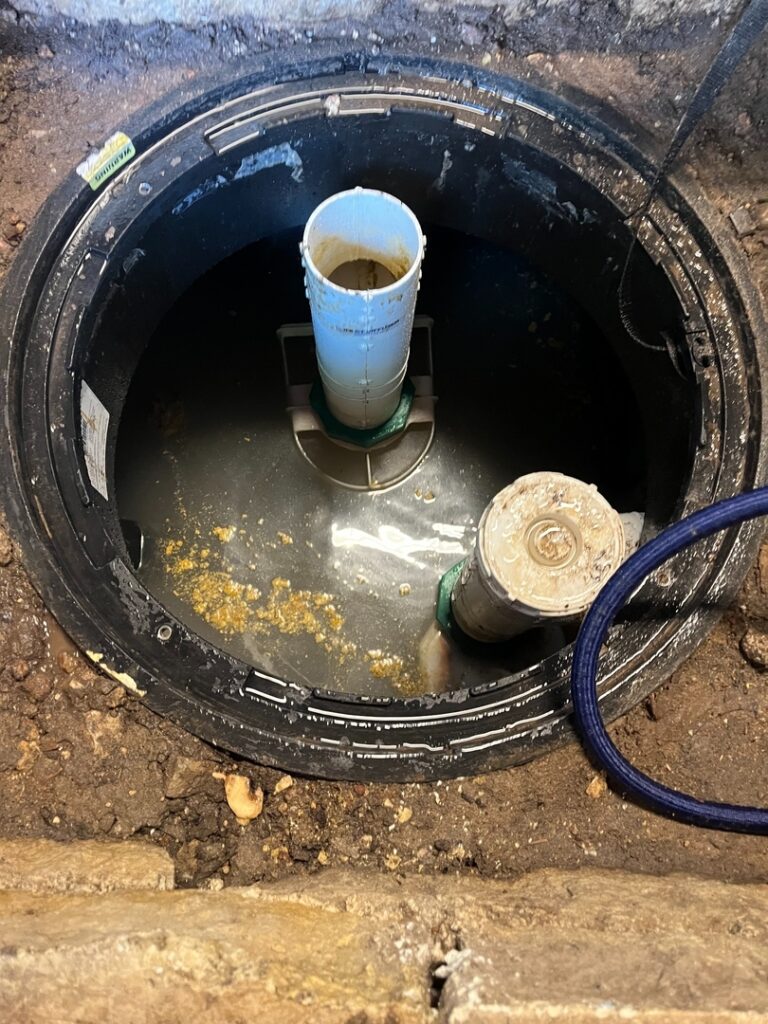
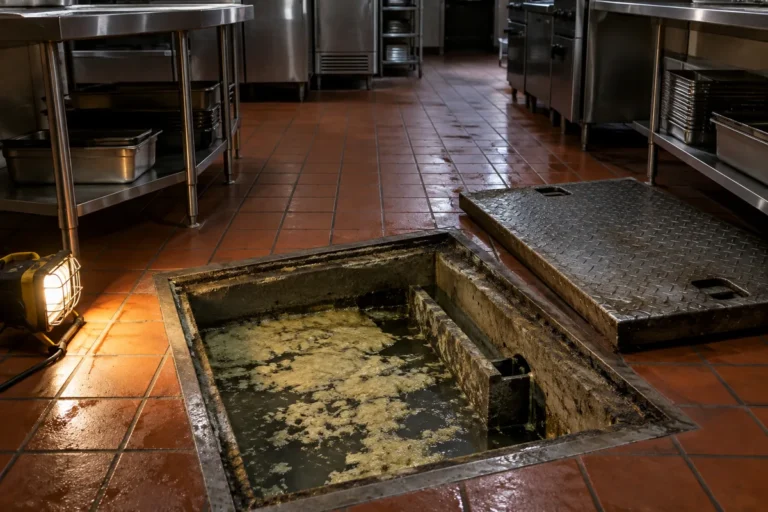
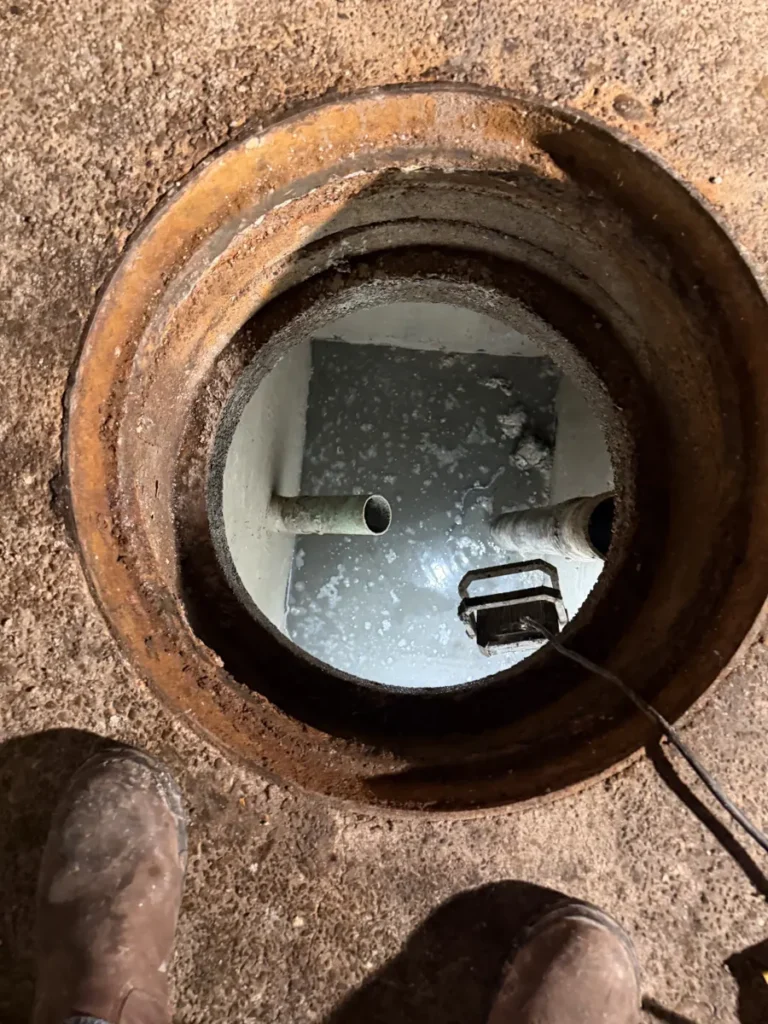
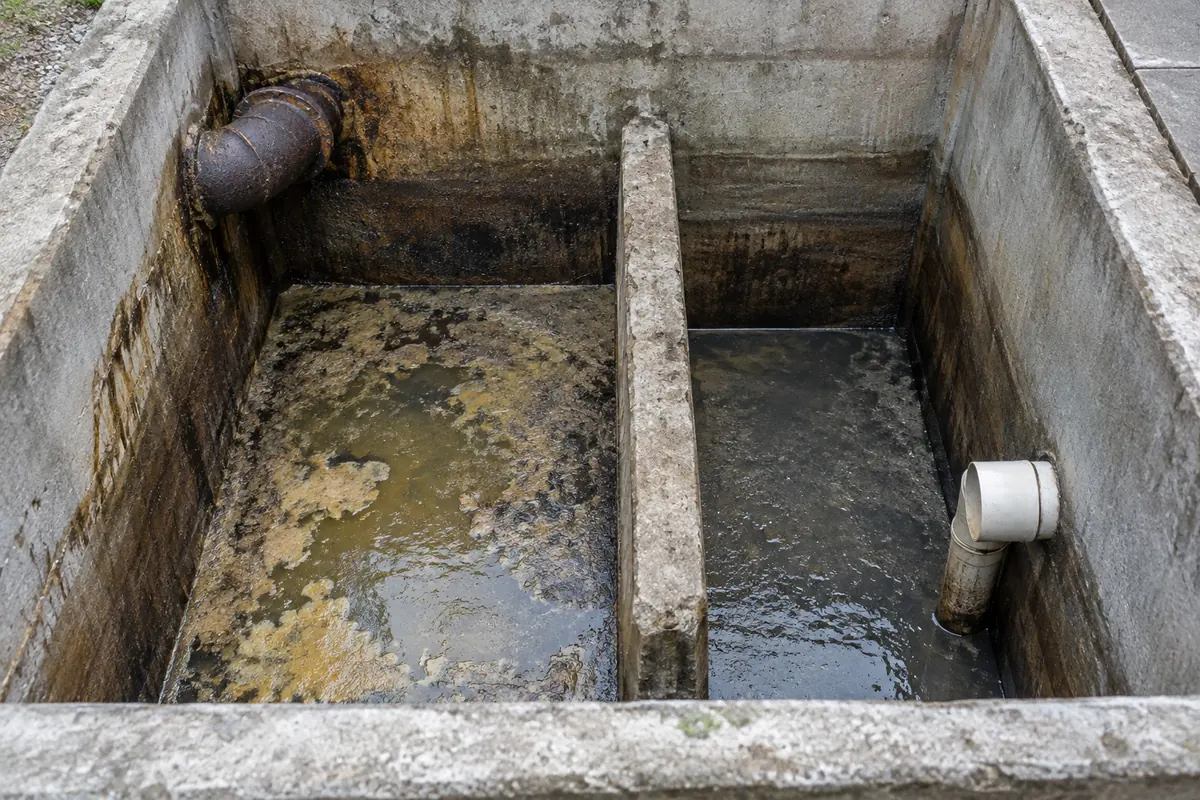
The inlet pipe is how your kitchen’s wastewater gets into a grease trap, and the outlet pipe is how the separated water leaves for the sewer line. If either one is cracked or corroded through, we repair it, and if a pipe is completely gone, our crew fits a new one. A trap that is simply full is your pumping company’s job, and a plugged pipe needs clearing, not repair. None of these on its own means buying a new trap.
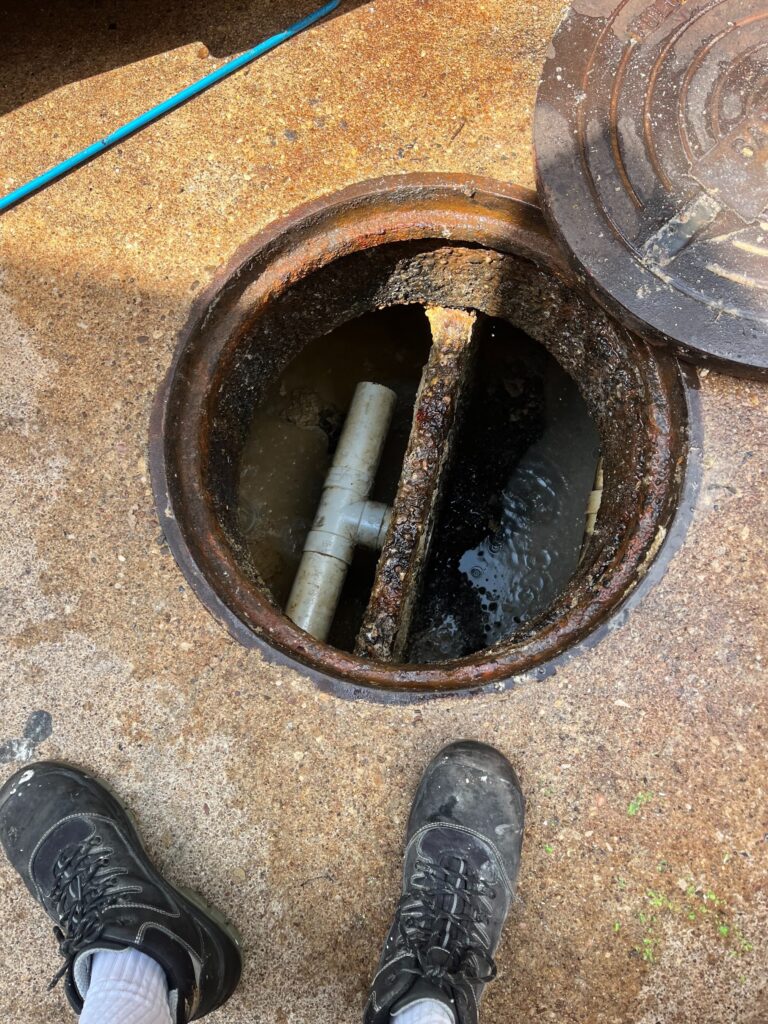
Some traps also have a T-shaped fitting on the end of a pipe. The one at the exit has its own post, on the grease trap outlet tee. For the whole system, read how a grease trap works.
What do the inlet and outlet pipes of a grease trap do?
Inlet pipe: the one way in
Everything entering the tank is meant to arrive through this pipe. Austin Water puts the kitchen’s side of that plainly: “All fixtures with the potential to carry grease-bearing wastewater or solids must be plumbed to the grease trap or interceptor.” An interceptor is a larger grease trap.
The pipe also has to deliver that water without stirring the tank, since separation depends on calm water and time. Austin Water’s sizing page says “In most cases, grease trap sizing requires a 12-minute total retention time”. Water that rushes in or takes a shortcut uses up those minutes.
Outlet pipe: the way out, and the water line
This pipe carries the separated water out of the tank and on toward the sewer. It also decides how full a working trap stands. In our own reading of how the parts fit together, water at rest settles level with the invert, the pipe’s lowest inside edge, and anything higher runs out. Austin’s code uses that same point, as you’ll see below.
Other parts along the route
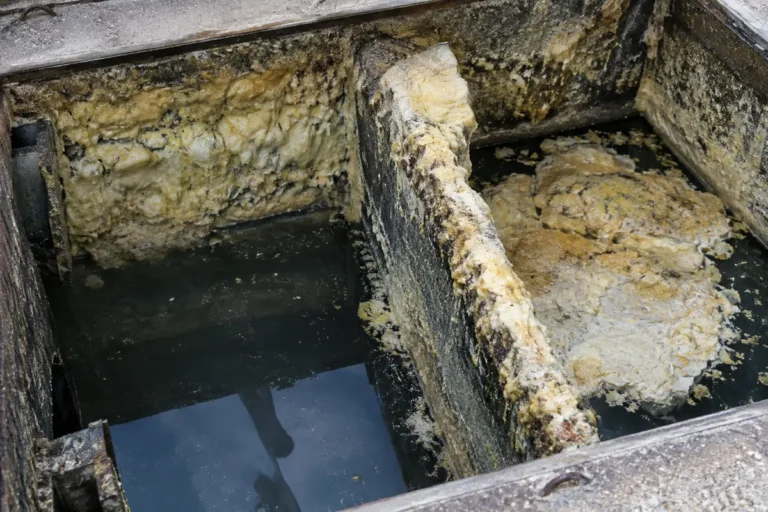
Between the two pipes stands the baffle wall. An inlet tee turns incoming water downward so it doesn’t splash across the top. A cleanout, at the outlet or just past it, gives access for removing a blockage from the pipe. A vent lets air into the space above the water, so flow through the pipes doesn’t siphon the trap.
How do grease trap inlet and outlet pipes fail?
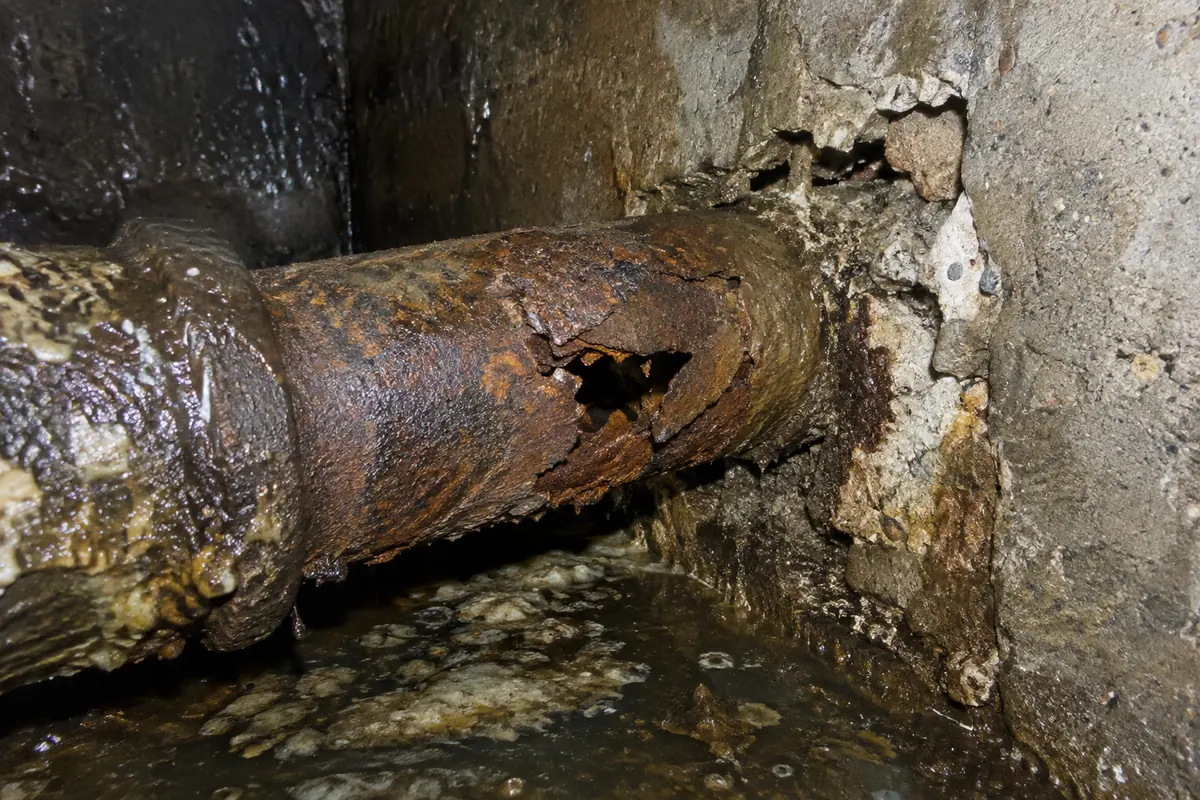
“A bad pipe” can mean any of five things, and they lead to different phone calls. Where a line has no named source, it’s our own reading and not a published finding.
- Plugged. Grease and solids have packed the pipe or its mouth, and the pipe underneath may be sound. EPA-hosted training slides for wastewater operators warn that at an inlet with no tee, the “FOG layer itself can block inlet wastewater flow”. FOG means fats, oils and grease.
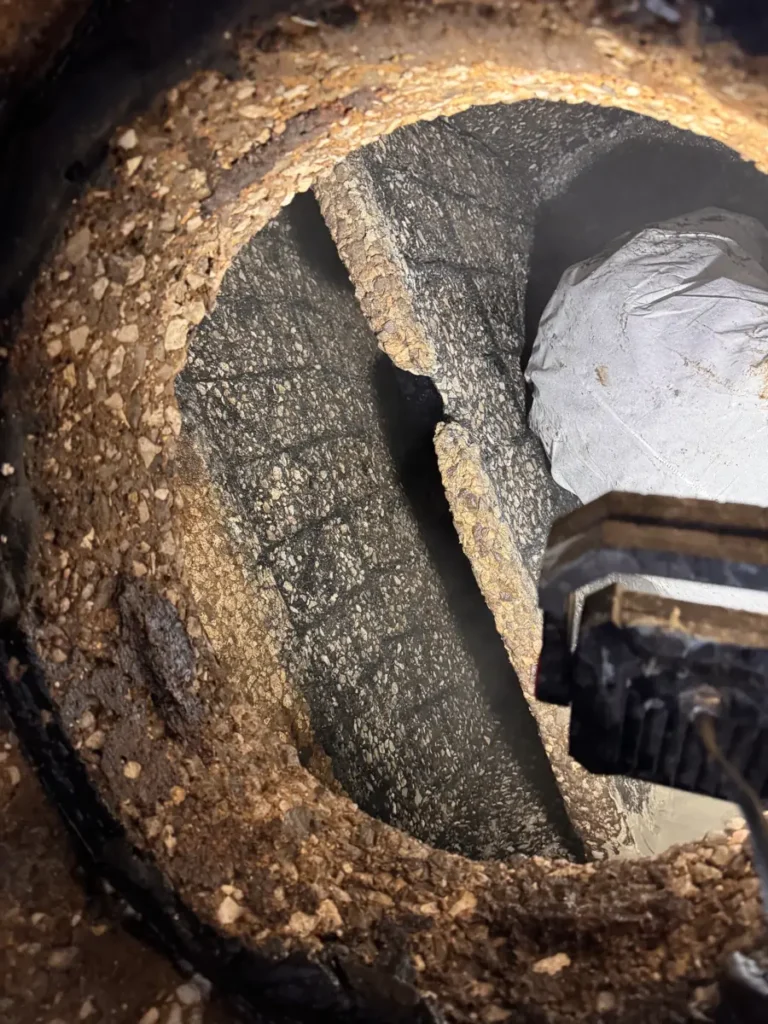
- Corroded. EPA’s sewer corrosion report describes hydrogen sulfide gas attacking “copper, iron, and steel”, and sulfuric acid forming “on moist, non-submerged surfaces”, where it eats concrete. Applying that to a trap’s pipes and the concrete around them is our own reading.
- Cracked, holed or pulled away from the wall. We found no published figures on this. A gap where a pipe passes through the tank wall is a place water can escape, so see why grease traps leak.
- Fitted with the wrong parts. A field case in the same slides lists “Fernco/rubber fittings used inside of trap” among one trap’s problems.
- Gone. The section inside the tank is no longer there, so nothing directs the water.
Where each end shows its trouble
Inlet faults tend to show up in the kitchen and in poor separation. Of a trap with no inlet tee, the slides say “Clogs, backups in facility are more likely” and “Shortcircuiting of kitchen wastewater occurs”, meaning water gets through before the grease has separated. They’re describing the tee, and we read a broken-off inlet end the same way.
Outlet faults tend to show up in the tank and beyond it. A blocked outlet holds water in. A broken one can pass more grease along, and EPA says grease in sewers “solidifies, reduces conveyance capacity, and blocks flow”, so the trouble can return later as a backup farther down the line.
Is the pipe damaged, blocked, or is the trap just full?
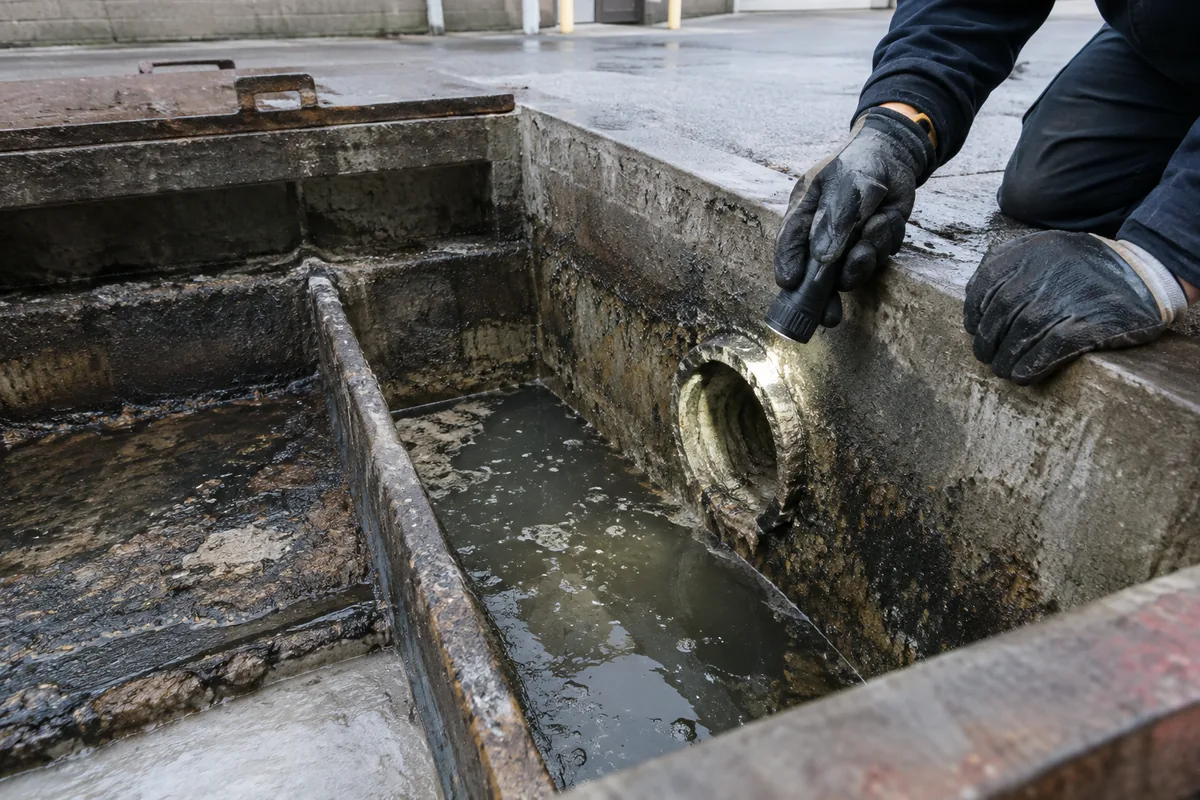
Pump-out problem or repair problem?
Start with the calendar. Trade sources, not official guidance, list slow draining, gurgling and backups at sinks and floor drains as the usual signs of a full or overdue trap. If your pump-out is due, rule that out first. If the trap was just emptied and the symptoms continue, look at the pipes and the lines attached to them.
Please don’t open the trap to check: its opening is a confined space that can hold hydrogen sulfide and other dangerous gases. The trap also has to be emptied before anyone can judge the inside. Austin Water’s advice is to “Be present for GT pump-outs” (GT is grease trap) and to discuss “the condition of the pretreatment device itself”.
| What you’re seeing or being told | What it points to | Who to call |
|---|---|---|
| The pump-out is overdue, or grease has built up around the pipes | A full trap | Your pumping company. We don’t pump traps or haul waste |
| A pipe is plugged at the tank, with no crack or missing section | A blockage, not damage | Your pumping company while they’re there, or a plumber |
| The trap was just emptied, and the line before or after it is still backed up | Likely a blockage in the line | Us, about sewer line jetting, or a plumber |
| A pipe is cracked, holed, corroded or pulled away from the wall | Damage | Us, for a free on-site inspection |
| An inlet pipe, outlet pipe or T-pipe is completely gone | A missing part | Us. Our crew fits a new one, for every trap type |
| Water sits below the outlet pipe with nothing draining (trade sources read this as a leak) | Possibly a leak in the tank | Us, for a free on-site inspection |
| Pipes look sound, pump-outs are on time, and heavy grease still reaches the sewer | Possibly a drain that bypasses the inlet | Not our work. Ask a plumber about a dye test of the kitchen’s fixtures |
Your permitted pumping company empties the trap and takes the waste away. Our sewer line jetting clears blockages in the line, up to 200 feet from each side of the trap, on both the inlet side and the outlet side.
Which end is blocked?
As a rough guide, and our own reading rather than a published test: with the inlet side blocked, the kitchen backs up while the tank doesn’t fill. With the outlet side blocked, the tank’s level climbs above the outlet pipe. Whoever has the lid open can see which.
So at the pump-out, ask your hauler where the water stood against the outlet pipe, whether both pipes are still in place, and whether either one has a crack or a gap at the wall. Then ask whether the two openings were clear once the tank was empty. PDI-G101, the standard for compact interceptors, makes that check part of cleaning. Have the answers written on the manifest, the paperwork left after each pump-out.
What do Austin’s rules change for inlet and outlet pipes?
We can’t tell you a damaged pipe will fail an Austin inspection by itself, because we haven’t found an Austin source that says inspectors check these pipes or fail a trap over them. Here is what Austin does say.
The measurement runs to the outlet pipe. Under § 15-10-197, a trap has to be cleaned “at least every ninety days”, or sooner, “when 50 percent or more of the wetted height of the grease trap, as measured from the bottom of the grease trap to the invert of the outlet pipe, contains grease and solids”. Keeping to that schedule won’t mend a broken pipe, and mending a pipe won’t change the schedule.
Austin Water wants problems handled quickly. Its maintenance page, which is guidance and not code, says “Promptly address slow drains, backups, overflows, leaks, or other plumbing issues.” On paperwork it’s firmer: when a pump-out manifest shows the trap “needs repair”, take action “to have it serviced immediately”.
New interceptors have set pipe heights. For new gravity interceptors, the large tanks usually buried outdoors, Austin Water’s design criteria say “The inlet must be near an elevation equal to half the tank’s static water level height; the outlet must be at least 12 inches above the tank floor”. Static water level is the height the water rests at. The page doesn’t say whether those heights run to the pipe or to a fitting on its end, and an older trap may be built differently.
Already failed? Here’s what to do after a failed grease trap inspection in Austin.
Does a damaged or missing pipe mean a new trap?
Not on its own. Most grease traps can be repaired rather than replaced, and pipes are among the parts we work on, along with T-pipes and everything else inside the tank, in cast concrete, steel and fiberglass traps of all sizes, underground or above ground. If an inlet pipe, outlet pipe or T-pipe is completely gone, our crew fits a new one, and that holds for every trap type.
Call for a free on-site inspection, and tell us when the trap was last pumped, since the inside can only be judged once it’s empty. Your pumping company has to empty it before work begins. Then our crew comes in overnight, after you close, and the trap is ready the next morning, so the kitchen doesn’t have to shut. More on grease trap repair in Austin.
The promises on a pipe repair
These also apply when only one part is repaired, and the technician will confirm the terms for your job at the inspection. A repaired trap is guaranteed to pass inspection, backed by high industrial-grade materials, work to the original specifications and coordination with the city inspectors on any inspection needed. That guarantee concerns the trap’s repaired condition, so pump-out dates and manifests remain yours to keep up. You also get a 10-year warranty on labor and materials, as long as the trap gets regular pump-outs. Repair typically comes to under half the cost of replacement, measured against a new trap you pay to buy and install. Prices aren’t published, because they turn on the size of the trap and the amount of damage.
When replacing is the honest answer
A bad pipe doesn’t decide this, but the tank around it might, if it’s past saving or too small for the kitchen. We install new traps too. Austin Water warns “Do not purchase a grease trap or interceptor before obtaining building plan approval and an Industrial Waste approval letter”. Its Grease Trap Relief Program has, since October 1, 2026, offered no-cost equipment and installation or replacement to qualifying and approved businesses, though applying doesn’t guarantee approval. Read what to check before replacing a grease trap in Austin.
More questions about grease trap inlet and outlet pipes
Should the inlet pipe sit higher than the outlet pipe?
Austin Water’s criteria don’t compare the two directly. For new gravity interceptors, they say the flowline, the bottom of the incoming pipe as it nears the trap, “must be at least 3 inches above the tank’s static water level”. Since the outlet sets the resting water level, we read that as putting the incoming line above the outlet.
What size should the pipes be?
Austin Water’s design criteria page doesn’t give a pipe diameter. If you’re planning a new trap, ask Industrial Waste staff during plan review.
Does the inlet pipe need a tee?
The EPA-hosted slides, which are training material and not an Austin rule, say “No Inlet Tee is a problem”. Austin Water’s criteria for new gravity interceptors don’t name a tee, but they require “Adequate flow diffusion features” to spread incoming water evenly.
Sources
- City of Bellevue, WA Utilities, Fats, Oils and Grease: How the System Works
- Plumbing and Drainage Institute, standard PDI-G101 for hydromechanical grease interceptors
- U.S. EPA, Hydrogen Sulfide Corrosion in Wastewater Collection and Treatment Systems, Report to Congress
- U.S. EPA, National Pretreatment Program fact sheet on food service establishments
- U.S. EPA, Fats, Oils and Grease webinar slides (PDF) (NPDES Operator Webinar, October 2023)
- Austin Water, Grease Trap Relief Program (retrieved October 2026)
- Austin Water, Grease Trap Sizing and Design Criteria (retrieved September 2026)
- Austin Water, Grease Trap Maintenance (retrieved October 2026)
- Austin City Code, § 15-10-197, Requirements for cleaning grease traps (Municode, version of August 26, 2026, read November 2026)
Updated November 2026
Has a manifest or an inspector flagged one of your pipes?
Austin Water’s word for a manifest that says a trap needs repair is “immediately”, so a cracked, corroded or missing pipe shouldn’t wait for the next pump-out. Call (512) 801-4131 any hour. We’re open 24/7, and a person answers and books your free on-site inspection. If the trap is only full, your pumping company comes first, and if the line stays backed up after they’ve been, ask us about jetting.