Grease Trap Construction: How a Commercial Trap Is Built, and Why It Matters
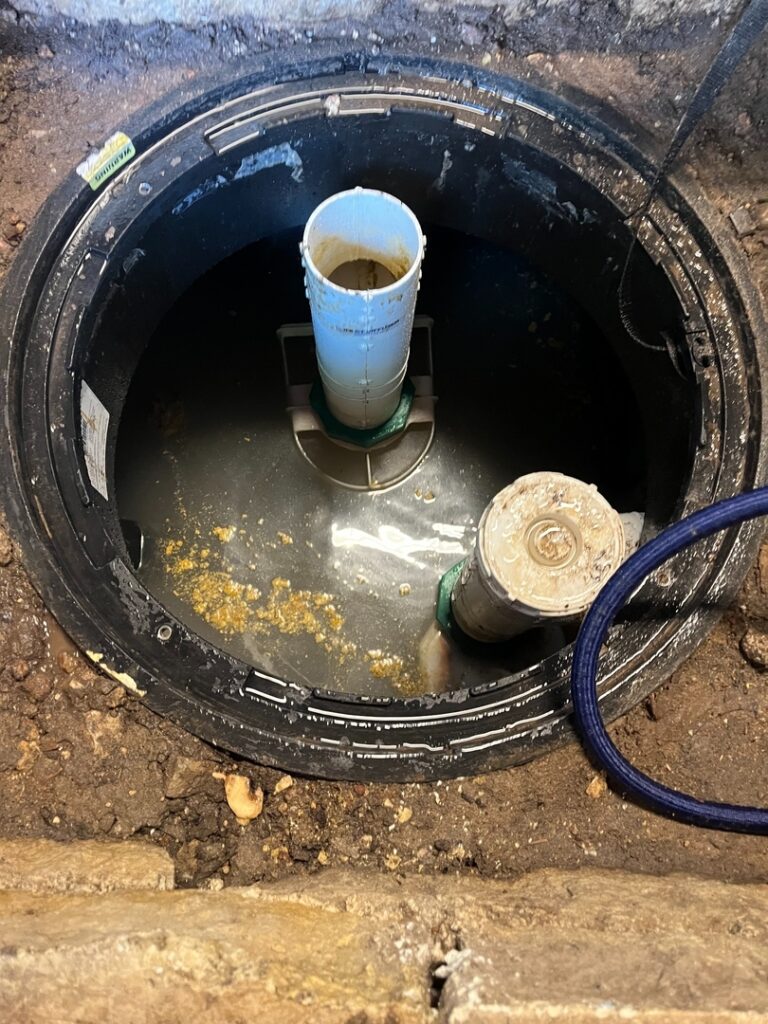
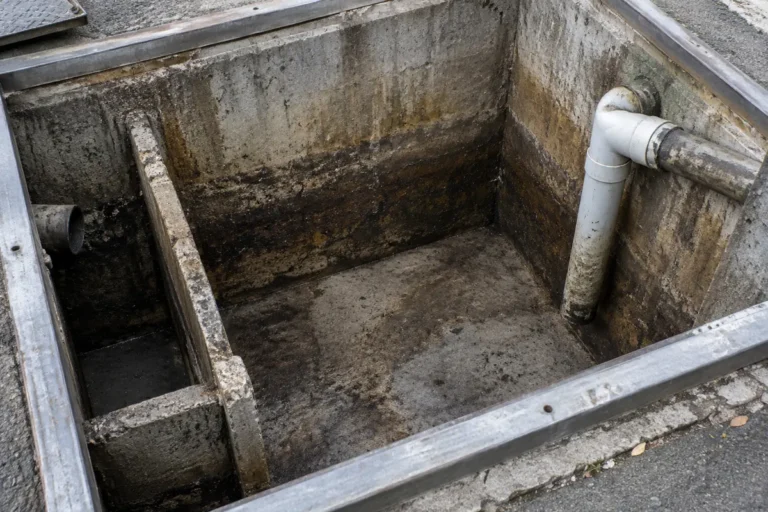
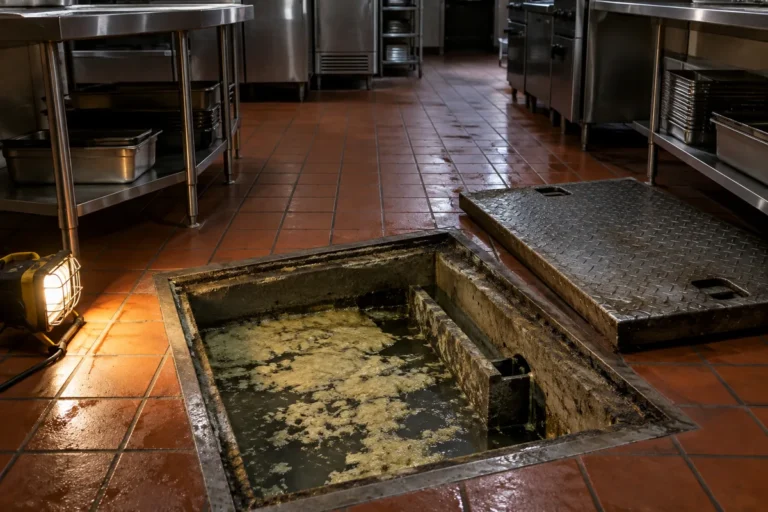
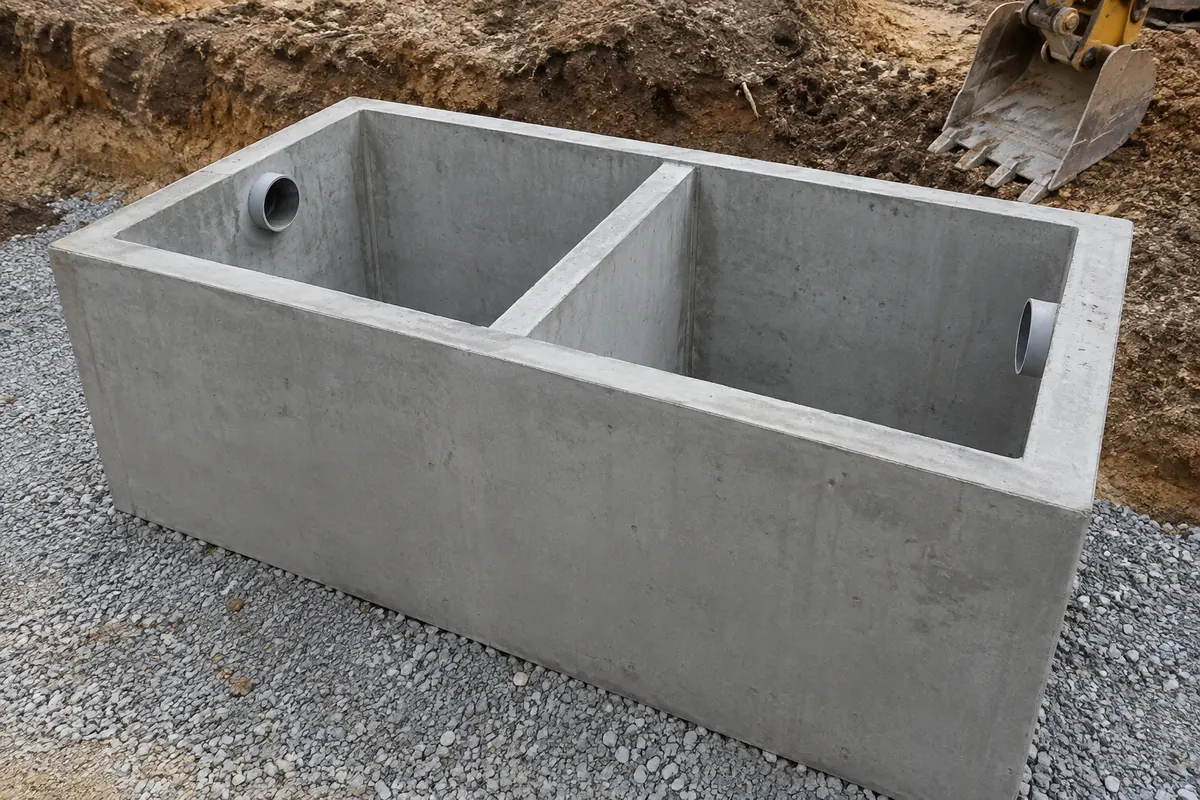
A large commercial grease trap is a tank, usually precast concrete and sometimes steel, fiberglass or plastic, with a baffle wall dividing it into compartments. Smaller units installed indoors often have a single compartment. Wastewater comes in through an inlet pipe and leaves through an outlet pipe, often fitted with T-shaped pipes called tees, and the tank has vents for air and lids for access.
In Austin, a new trap’s size and design are set in an approval letter before it’s bought. This guide is for restaurant and facility managers who already have a trap in the ground and want to follow what an inspector, a pumper or a repair technician says about it. To follow the water’s path through the tank, read how a grease trap works.
What materials are used in grease trap construction?
The product standard for large in-ground traps, ANSI/CAN/IAPMO Z1001, covers units “made of concrete, fiber-reinforced polyester (FRP), thermoplastic, or steel”. Fiber-reinforced polyester is what most people call fiberglass. Thermoplastic means a molded plastic.
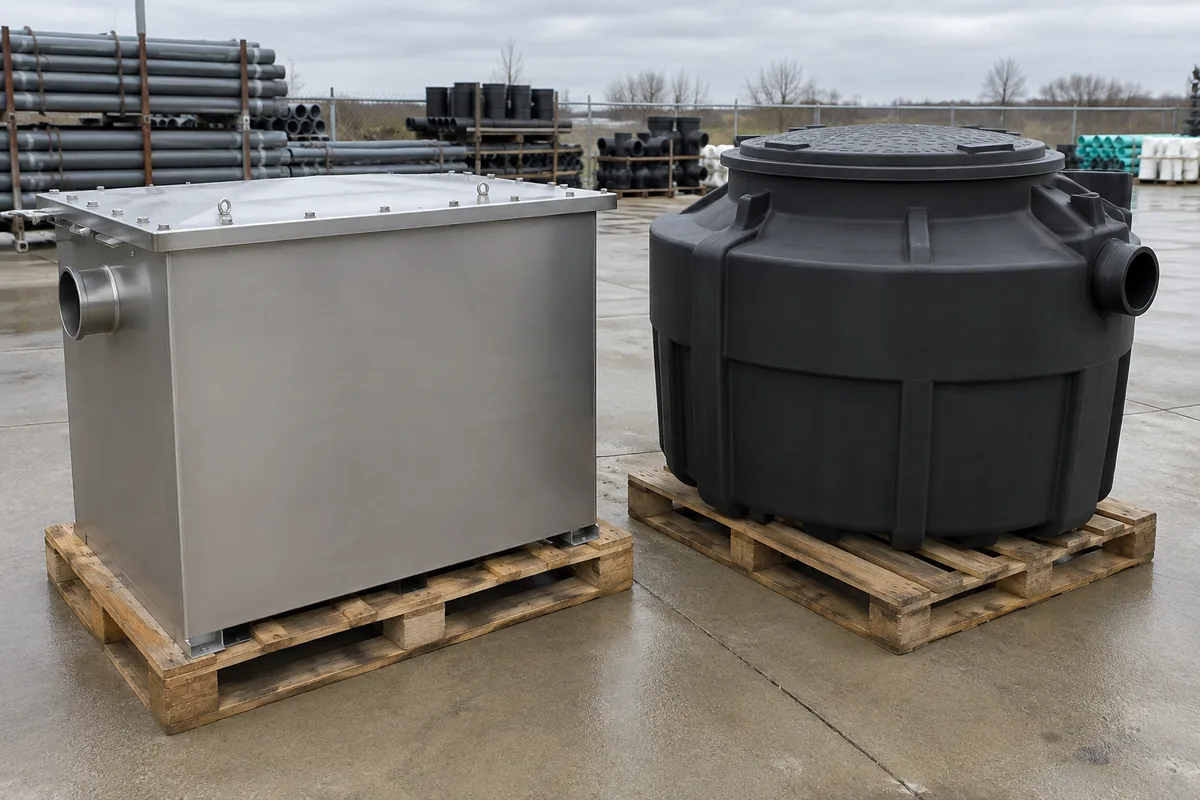
Precast concrete
Austin Water’s pretreatment FAQ describes the usual trap here as one of the “large pre-cast concrete tanks ranging from 250 to 10,000 gallons, with two compartments that allow separation and retention time.” Precast means the tank is cast in a mold before it reaches the site, then set in the ground. Austin’s rule for its large in-ground design allows concrete or another non-corrodible material.
Steel
Steel is one of the four materials the national standard covers, and Austin Water lists stainless steel among the materials for engineered traps, which Austin treats as a variation on the concrete design.
Fiberglass and plastic
The same FAQ says engineered traps “may be made of thermoplastic, fiberglass, polyethylene or stainless steel”. It describes the compact units installed indoors, called hydromechanical grease interceptors, as “typically single-compartment fiberglass or polyethylene units.”
Austin doesn’t rank the materials. Industrial Waste staff, the City office that approves grease traps, set the size and design for each kitchen.
How grease trap construction fits together
One-piece and two-piece tanks
A concrete trap can be cast as a single body closed with a separate cover. EPA-hosted training slides for sewer system operators call that design “Monolithic” and define it as “Tank Body with Cover/Lid”. So even a one-piece tank has a joint where its cover sits on the body.
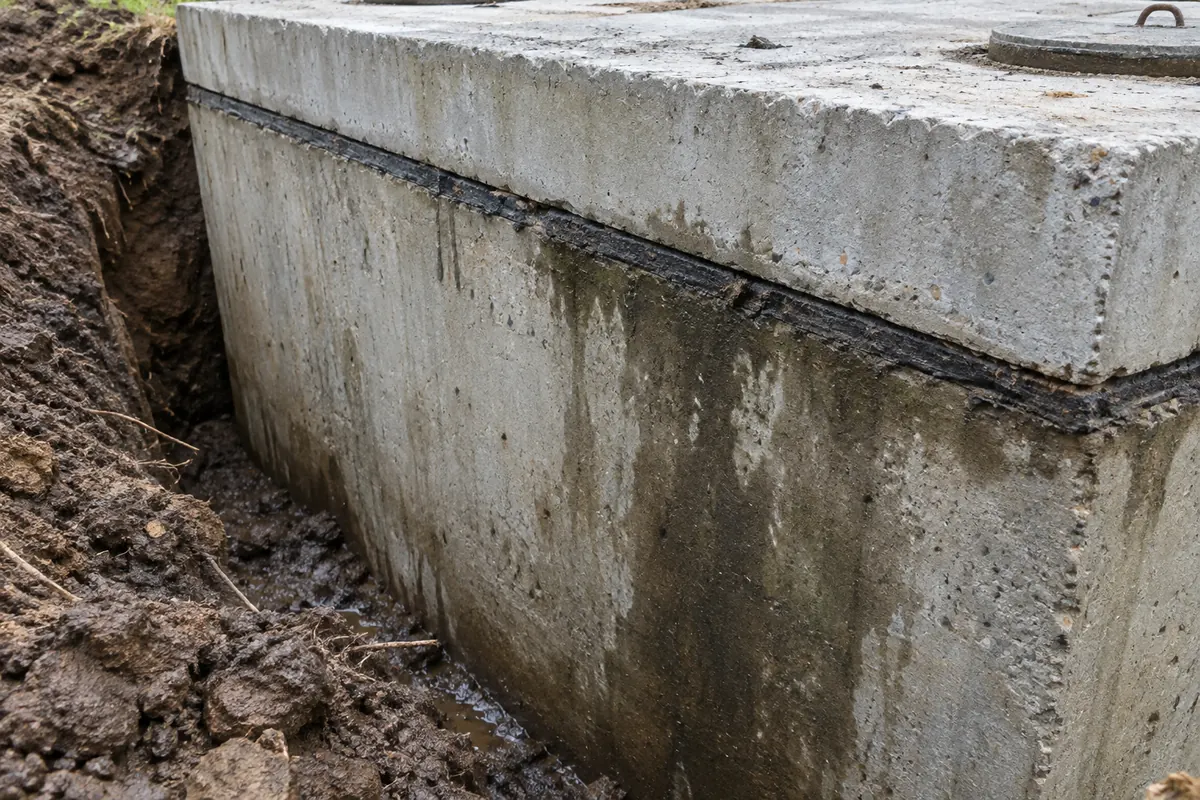
Some older interceptors were built differently, from two body sections stacked one on the other. The same slides show “Older Two Piece Interceptor Seams” from inside the tank, as a horizontal line across the wall where the sections meet, and one photo is captioned “Interceptor leaking at two piece seam”.
Where a kitchen has two tanks, the slides label tanks connected one after the other, in series, “Less potential issues, preferred set up”, and tanks side by side, in parallel, “More potential issues”. They’re training material, not an Austin rule.
Compartments and the baffle wall
The baffle wall splits the tank into compartments. A Washington city utility’s guide puts the reason simply: “grease floats and will generally not go under the baffle”.
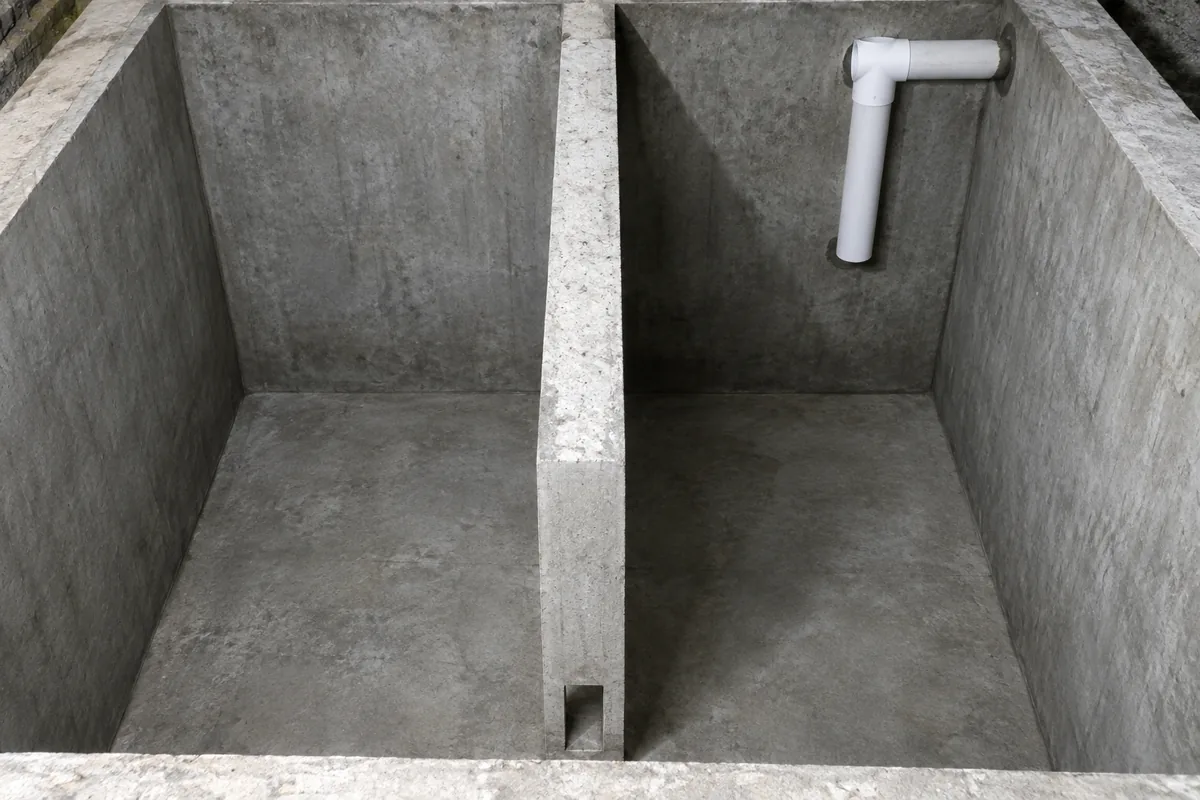
Austin sizes the two compartments by retention time, meaning how long the water stays in each one: “no less than seven minutes and the second no less than five minutes (approximately 60/40 split)”. More on the wall itself in the grease trap baffle wall.
Inlet, outlet and tees
Everything entering the tank comes in through the inlet pipe, and the separated water leaves through the outlet pipe. The EPA-hosted slides say “No Inlet Tee is a problem”, because it “Does not allow for proper retention time”, and that “Outlet Tee is critical”.
Austin asks its large in-ground traps for “Adequate flow diffusion features”, meaning parts that spread the incoming flow evenly, and gives examples: “a flow diverter plate in the primary compartment, ‘tee’ piping between the two compartments and ‘tee’ piping on the tank outlet”.
Austin also sets the pipe heights. “The inlet must be near an elevation equal to half the tank’s static water level height; the outlet must be at least 12 inches above the tank floor”. Static water level means where the water settles when nothing is flowing. The pipes have their own posts: inlet and outlet pipes and the outlet tee.
Vents
Vents feed air to the gap between the water and the top of the tank. Without that air, water rushing through can siphon the trap or build back-pressure. Austin says “The vent must be at least 3 inches above the static water level of the tank”, and “Inverts and vents must be external to the compartments”. An invert is the lowest inside edge of a pipe.
Lids, access and sampling points
Austin’s rule is “Each compartment must be accessible for cleaning and inspection”. PDI-G101, an industry standard for compact indoor interceptors, says to “Anticipate sufficient clearance for removal of interceptor cover for cleaning.” Some traps also have a sample box at the outlet end, so an inspector can take a sample of the water leaving, and a cleanout on the outlet line for clearing a blocked pipe.
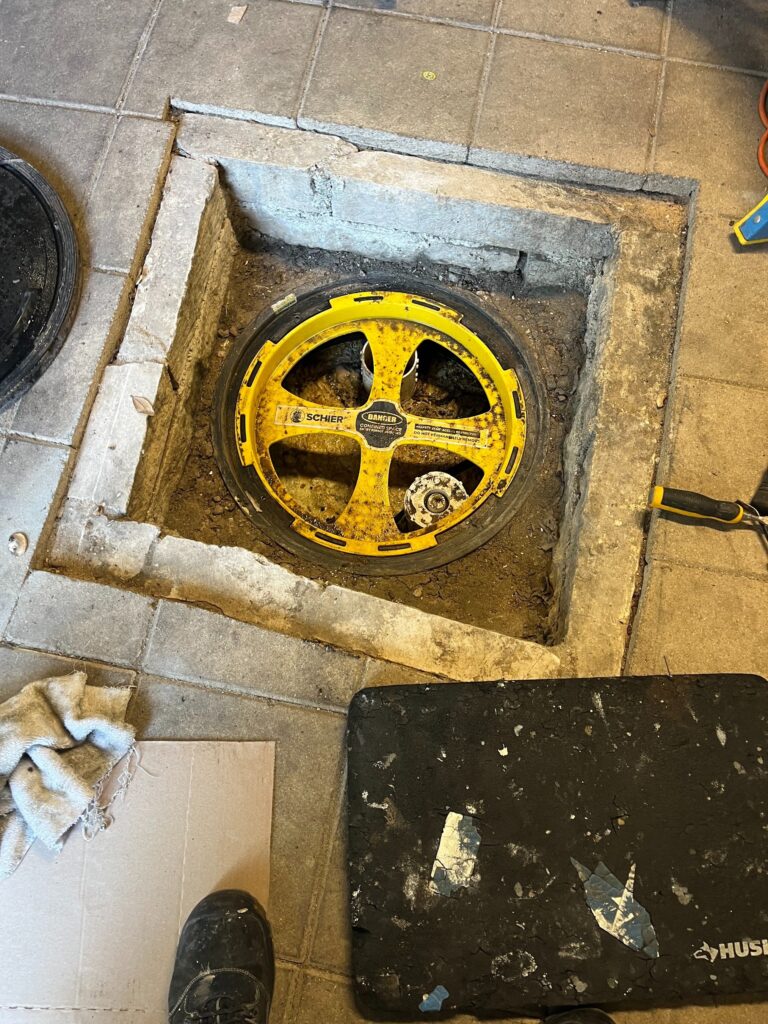
Don’t lift a lid yourself to look. Gases such as hydrogen sulfide can collect under it, and EPA training material treats sewer manholes, the same kind of opening, as confined spaces.
Austin’s rules for grease trap construction
Austin Water’s Industrial Waste program sets the design rules, and it “updated its grease interceptor policies in April 2021.” The first rule comes before anything is built: “Do not purchase a grease trap or interceptor before obtaining building plan approval and an Industrial Waste approval letter specifying the required size and design.” Units “with a minimum liquid holding capacity below 100 gallons will not be approved for installation,” and a kitchen with a dishwasher “must install a minimum 500-gallon (liquid holding capacity) grease interceptor.”
Austin’s rules use two abbreviations: GGI for a gravity grease interceptor, the large tank usually buried outdoors, and HGI for a hydromechanical grease interceptor, the compact unit usually indoors.
| Type | What Austin requires of the build |
|---|---|
| Gravity grease interceptor (GGI) | Built to the plumbing codes the City has adopted, “and installed in a manner acceptable to Austin Development Services”. Two compartments; “extremely large volume GGIs may have three compartments”. At least seven minutes of retention in the first and five in the second. “Must be constructed of concrete or non-corrodible materials”. Every compartment accessible for cleaning and inspection |
| Engineered gravity interceptor, a variation on the concrete design | “a 60/40 split between compartments for adequate retention time”, non-corrodible materials, and “either internal or external inverts”. Austin Water says the goal is “to closely follow the concrete GGI requirements while allowing slight flexibility when site conditions are not ideal for a concrete GGI.” |
| Hydromechanical grease interceptor (HGI) | “Must comply with ASME A112.14.3 standard”, “Must be flow-rated at 75 gallons per minute (GPM) or higher”, and non-corrodible materials. “HGIs greater than 500 gallons must have a 60/40 split between compartments”. Austin Water says they suit “small sandwich shops, coffee shops and bakeries that use disposable flatware and do not use an automatic dishwasher” |
“Exceptions may be considered through the Building Plan Review process”, with engineering drawings and performance data approved before installation. Austin Water also publishes an approved manufacturers list; it says “these manufacturers are familiar with Austin Water’s criteria.”
These are the criteria Austin applies when it approves a new trap. The page doesn’t say what they mean for a trap built before that update to a different design, and we haven’t found an Austin source that requires an older trap to be rebuilt to match. If that’s your question, ask Industrial Waste staff before you change anything.
Already failed an inspection? Read what to do after a failed grease trap inspection in Austin.
Where grease trap construction tends to fail
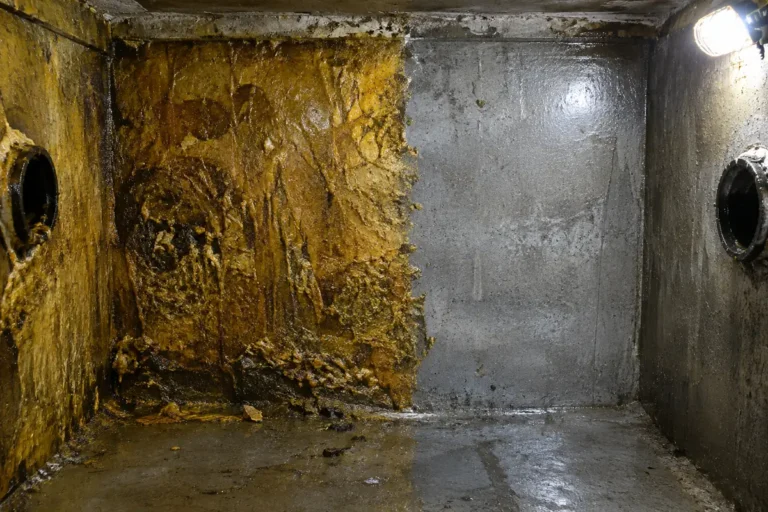
The EPA-hosted slides give two reasons grease control equipment corrodes. “FOG have weak acids, but can have corrosion impact” (FOG means fats, oils and grease), and an oversized trap “can allow hydrogen sulfide generation, corrosion, and odors”.
Concrete
EPA’s 1991 report on sewer corrosion, written for Congress, describes hydrogen sulfide gas turning into sulfuric acid on damp surfaces above the water in sewers, where the acid eats into concrete. EPA wrote about sewer pipes, not grease traps. Applied to a concrete trap, our reading is that the walls above the water line take the attack first.
Steel, fiberglass and plastic
We haven’t found a published source on how these materials usually fail in grease traps, so we won’t guess. Austin asks for non-corrodible materials on engineered and hydromechanical units.
Seams, the baffle wall and the tees
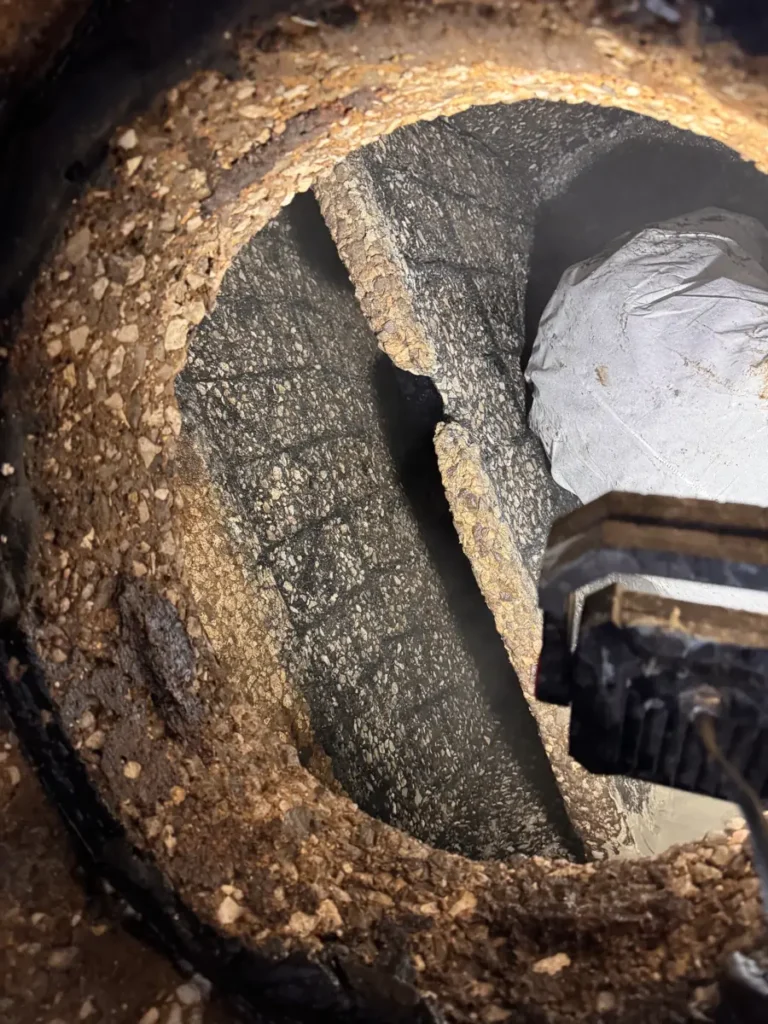
The slides show a two-piece seam leaking. Inside any tank, the baffle wall holds grease back because grease won’t go under it, so if the wall breaks, grease can ride through to the outlet even when the tank itself doesn’t leak. The slides call the outlet tee “critical” for the same kind of reason.
Damage, or a full trap?
A trap that’s simply full isn’t damaged, and it’s your pumping company’s job, not ours. We don’t pump traps or haul waste. Austin’s code requires cleaning “at least every ninety days”, or sooner once grease and solids fill 50 percent of the wetted height (§ 15-10-197).
| What you’re told or seeing | What it may point to | Who to call |
|---|---|---|
| Pump-out overdue, or grease and solids past half the tank | A full trap | Your pumping company |
| Drains stay slow after a fresh pump-out | Possibly a clog in the line, or a cause on the kitchen side | A plumber, or us for sewer line jetting |
| Cracks, holes, a broken baffle wall or a damaged pipe | Damage | Us, for a free on-site inspection |
| A pipe or T-pipe inside the tank has gone missing | A lost part | Us: our crew fits a new one |
At the next pump-out, Austin Water suggests you talk to your hauler about “the condition of the pretreatment device itself”.
What grease trap construction means for a repair
Most traps can be repaired rather than replaced. We repair cast concrete, steel and fiberglass traps of all sizes, underground or above ground, and any part inside: baffle walls, inlet and outlet pipes, T-pipes, deflectors, the floor and the walls. If an inlet pipe, outlet pipe or T-pipe is completely gone, our crew fits a new one.
A repair goes in four steps:
- A free on-site inspection. A technician looks at the trap. The price depends on the size of the trap and the amount of damage, which is why no prices are published.
- Your pumping company empties the trap. It has to be empty before work begins.
- The repair, overnight after you close. The trap is cleaned and degreased, all holes and cracks are repaired, broken walls are rebuilt, and the whole trap is coated. The method is called coating; you may also hear lining or relining.
- Ready the next morning. Your kitchen doesn’t have to shut for it.
A repaired trap is guaranteed to pass inspection, because we repair with high industrial-grade materials, back to the original specifications, and coordinate with the city inspectors on any inspection needed. Every repair carries a 10-year warranty on labor and materials, as long as the trap gets regular pump-outs. A repair typically comes to under half the cost of replacement. Read more on grease trap repair in Austin.
When a new trap is the honest answer
If the tank turns out to be beyond repair, or you’re told the kitchen needs a bigger trap, a new one may be the answer, and we install new traps too. In Austin, that starts with the approval letter, not the purchase. Read what to check before replacing a grease trap in Austin and grease trap installation in Austin.
More questions about grease trap construction
Is a concrete or a plastic grease trap better?
Austin doesn’t rank them. It accepts concrete or non-corrodible materials for gravity interceptors and asks for non-corrodible materials on engineered and hydromechanical units. For a new trap, the material that counts is the one your Industrial Waste approval letter allows.
How big does a new grease trap need to be in Austin?
Austin Water works it out from your fixtures. Count the fixture units, the values the City assigns to each sink and drain. Then, in Austin Water’s words: “Grease trap flow rating = total fixture units x 3 gal/min” and “Grease trap liquid holding capacity (gallons) = flow rating x 12 minutes.” Industrial Waste staff then apply “professional judgment”: “A larger trap than specified may be required in many cases; a smaller trap may be approved in rare circumstances.”
How do I find out how my grease trap is built?
Ask your pumping company, who open and empty it at every pump-out, and look for the trap’s approval letter or building plans if you have them. Austin Water’s tip is to “Be present for GT pump-outs” (GT means grease trap). Stay back from the opening while it’s open.
Sources
- Austin Water, Grease Trap Sizing and Design Criteria (read November 2026)
- Austin Water, Pretreatment Requirements and Resources FAQ (retrieved September 2026)
- Austin Water, Grease Trap Maintenance (retrieved October 2026)
- Austin City Code, § 15-10-197, Requirements for cleaning grease traps (Municode, version of August 26, 2026, read November 2026)
- IAPMO, press release on the Z1001 standard for prefabricated gravity grease interceptors (October 2021)
- Plumbing and Drainage Institute, standard PDI-G101 for hydromechanical grease interceptors (revised 2017)
- City of Bellevue, WA Utilities, Fats, Oils and Grease: How the System Works
- U.S. EPA, Hydrogen Sulfide Corrosion in Wastewater Collection and Treatment Systems, Report to Congress (1991)
- U.S. EPA, Fats, Oils and Grease webinar slides (PDF) (NPDES Operator Webinar, October 2023)
Updated November 2026
Grease trap construction damage found at inspection?
A cracked wall, a broken baffle or a missing pipe won’t fix itself at the next pump-out. Phone (512) 801-4131, day or night: we’re open 24/7, and a person picks up and books a visit for a free on-site inspection. A trap that’s only full needs your pumping company first.