Grease Trap Outlet Tee: Is It Broken, and Can It Be Fixed?
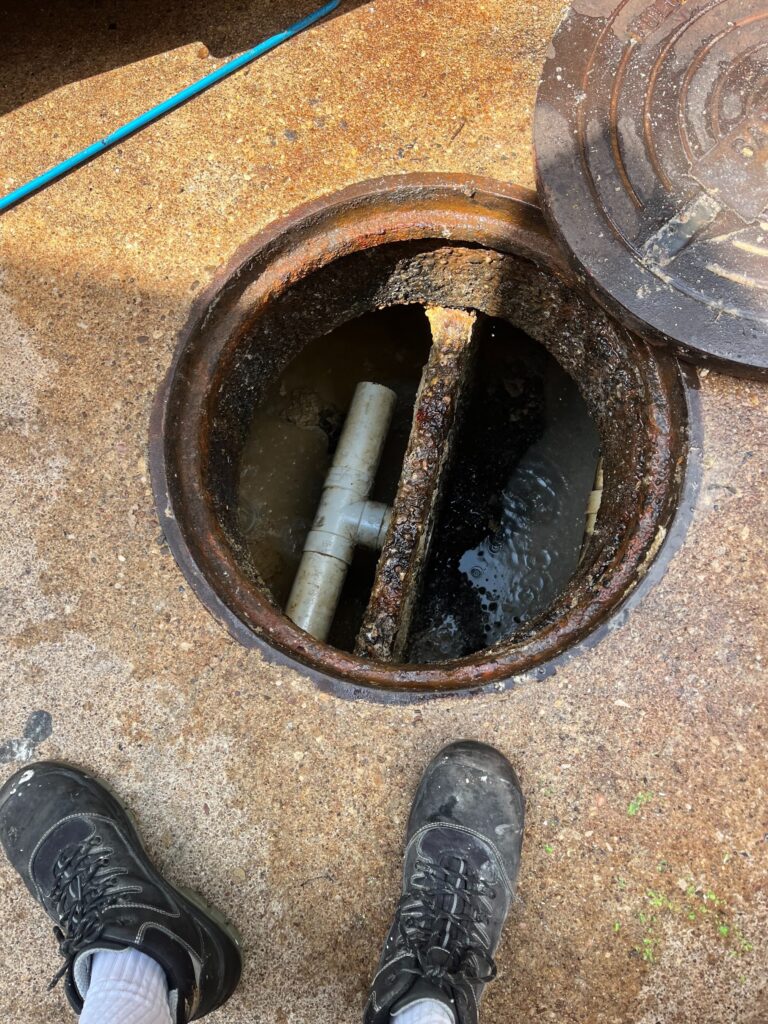
A grease trap outlet tee is the T-shaped fitting on the way out of the trap, with a leg that reaches down into the water so the trap releases water from below the floating grease. If yours is broken or corroded through, it may no longer keep grease out of the sewer, and that’s damage to a part we repair. If it’s missing altogether, we can fit a new one. If it’s only plugged with grease after a missed pump-out, the tee may not be damaged at all, and your pumping company or a plumber is the right call. Most grease traps can be repaired, so don’t assume you need a new one until someone has looked at the whole tank.
You may also hear it called a T-pipe, a tee or an outlet T. If your pumping company or an inspector has just named it, read on for what they probably saw, who to call, and what Austin’s rules change. For the trap as a whole, start with how a grease trap works, from sink to sewer.
What does a grease trap outlet tee do?
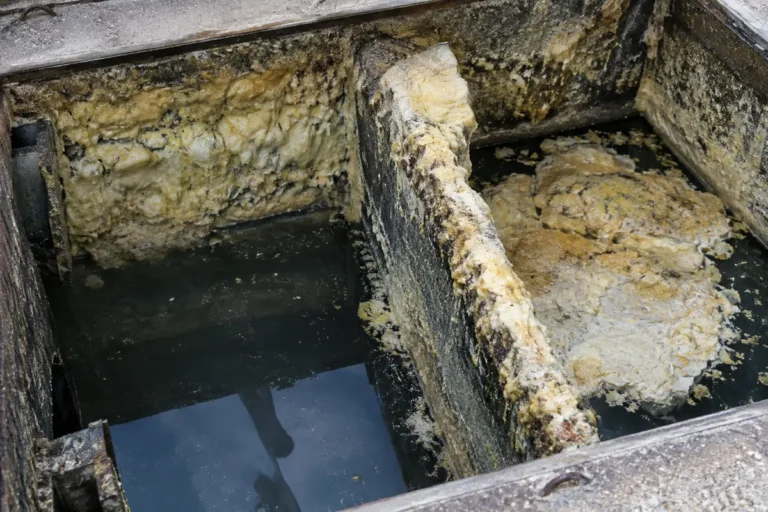
Think about what sits at the exit end of a working trap. Grease floats in a layer on top, food solids lie on the floor, and the clearer water is in the middle. Left open, the end of the outlet pipe would take in whatever reached it at the water’s surface, and that’s where the grease is.
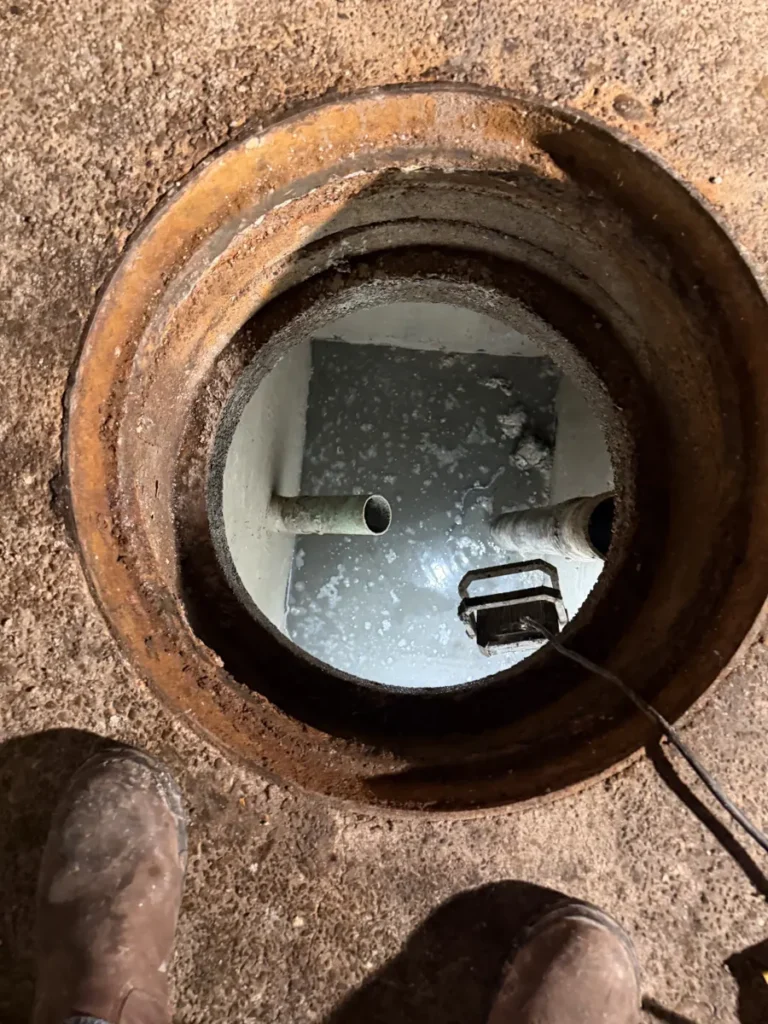
The tee closes off that route. It joins the end of the outlet pipe, and its lower leg points down into the water. The only way out is up through the bottom of that leg, so the water that leaves comes from beneath the grease layer.
An EPA-hosted training webinar for wastewater operators gives the part a slide of its own, headed “Outlet Tee is critical.” Its diagram of an interceptor calls the part the “Effluent T” and draws the leg reaching below the grease layer.
Outlet tee, inlet tee and baffle wall
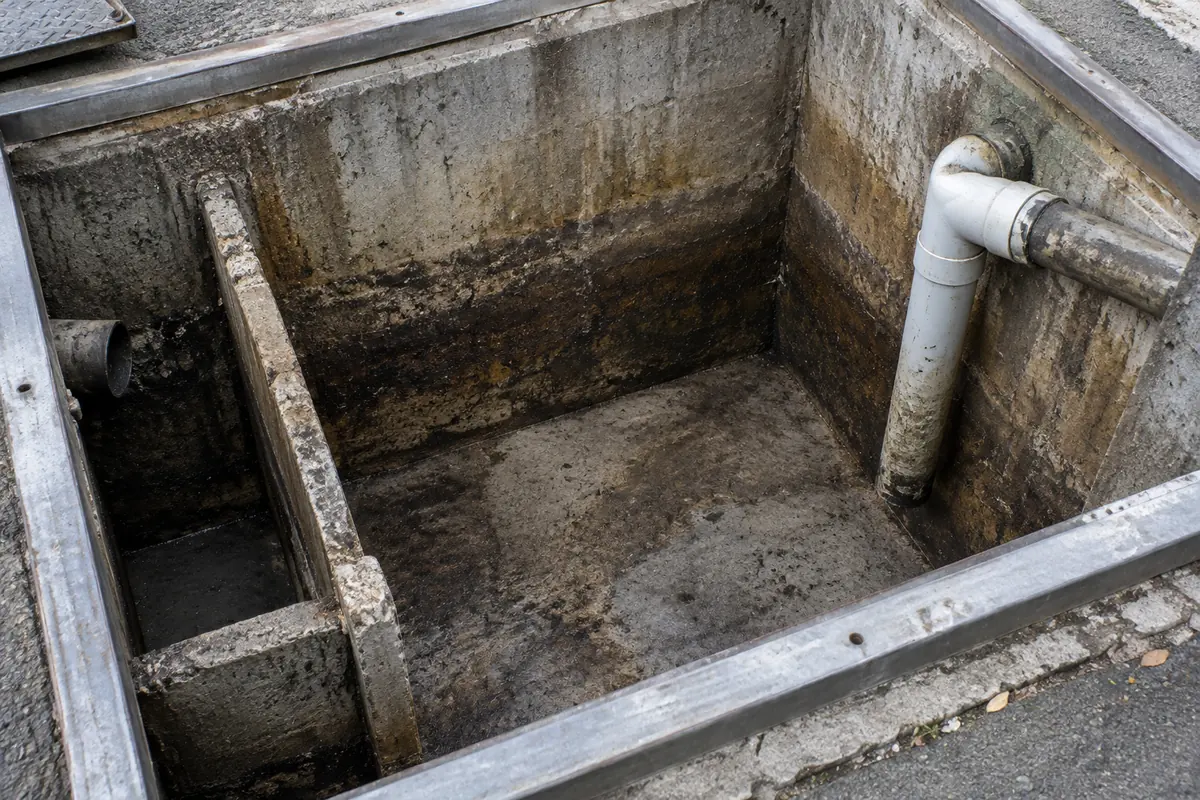
These are three separate parts. The inlet tee sits at the other end of the trap and turns incoming water downward. The baffle wall divides the tank and holds most of the grease in the first compartment; our post on the grease trap baffle wall covers it. The outlet tee is the last fitting inside the tank before the water heads for the sewer line.
How does a grease trap outlet tee fail?
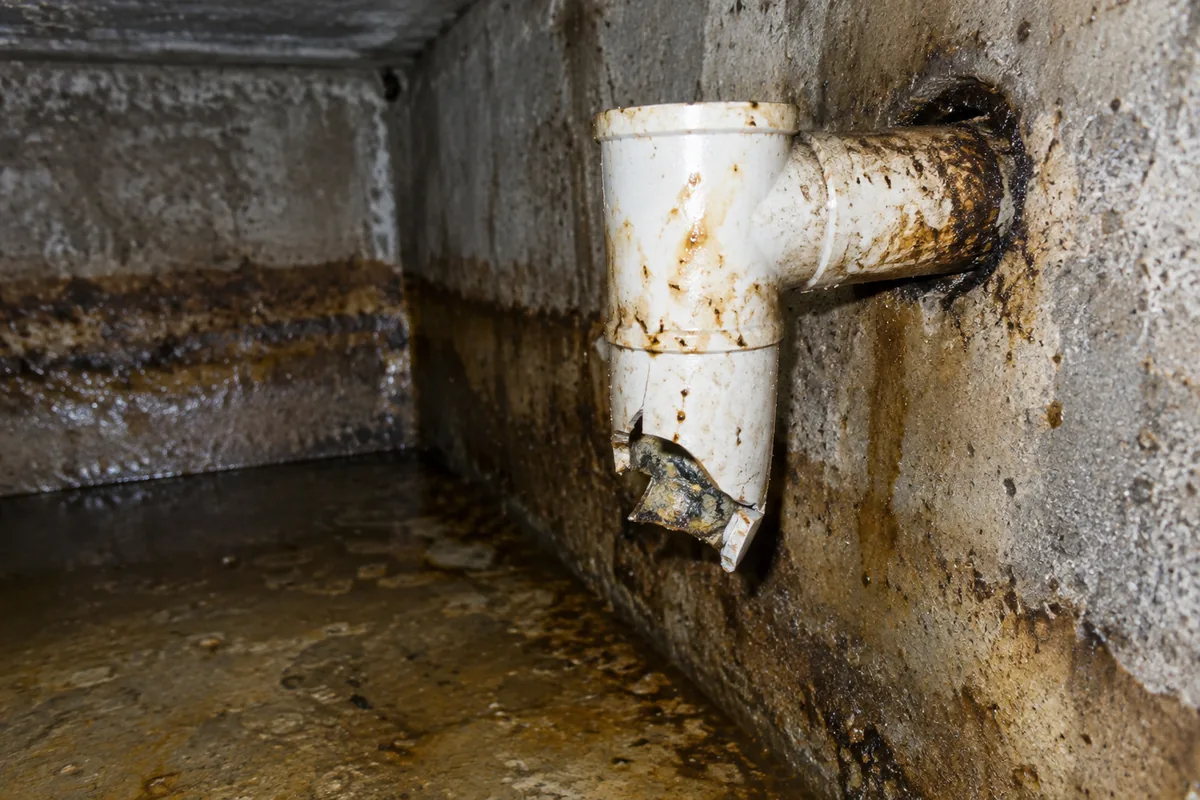
Five different problems get described with the same few words, and only some of them are repairs. Here and in the next section, an effect with no named source is our own reading of how the fitting works, not a published finding.
- Clogged. Grease and solids have packed the leg or the pipe behind it. The fitting itself may be fine.
- Missing. Nothing is fitted to the end of the outlet pipe, so it takes water from up near the surface.
- Broken or holed. Part of the leg is gone, or a hole has opened in it, so water can enter higher up, closer to the grease.
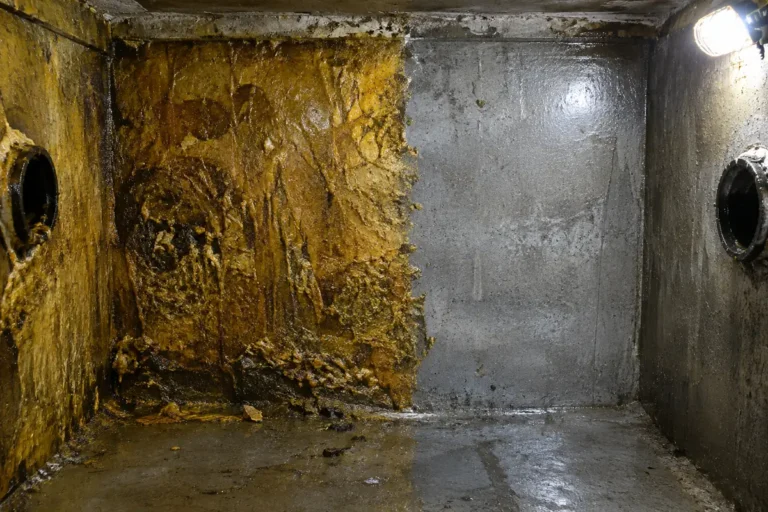
- Corroded through. As we read EPA’s work on sewer corrosion, waste left sitting in a trap can produce hydrogen sulfide gas. EPA describes that gas attacking iron and steel directly, and a metal tee standing in the air space above the water is exposed to it.
- The wrong part, or fitted the wrong way. The EPA-hosted webinar marks “Alternative Tee material & direct wall attachment” as “no good”.
One interceptor manufacturer warns that a corroded outlet tee can let too much grease escape into the sewer. That company sells plastic tanks and has a commercial interest in the point, but it matches what the fitting is there to prevent.
For the chemistry behind corrosion and where else it shows up in a trap, see why grease traps leak.
A missing tee can go unnoticed from the kitchen for a while, because the water still has a way out and the sinks can keep draining. The person likely to find it is whoever is standing over the open tank.
My grease trap is backing up. Could it be the outlet tee?
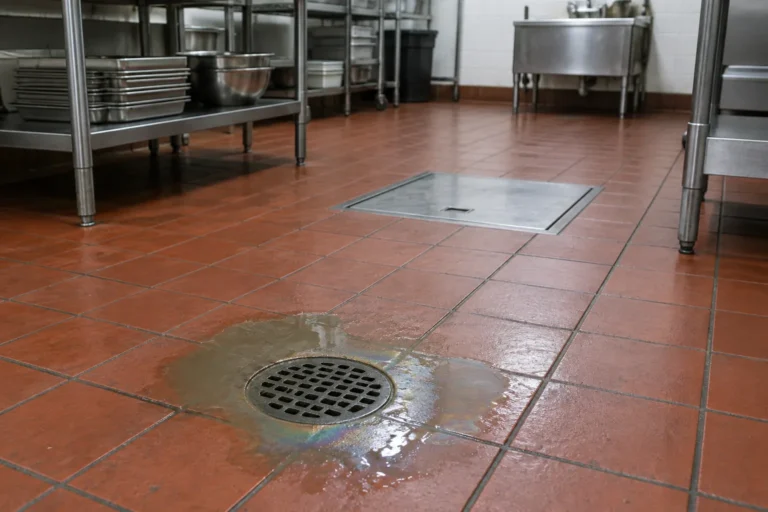
It can be, if the tee or the pipe behind it is blocked. Water that can’t get out through a plugged exit stays in the tank and rises toward the kitchen. A trap that is simply overdue for a pump-out can act the same way, so rule that out first.
A missing tee works differently. The way out stays open, so it’s less likely to back the trap up on its own. What it does is let more grease into the line past the trap, and EPA says grease hardens in sewer pipes and narrows them. Over time, the backup can start out there instead.
A backup can also come from the opposite end of the trap. The EPA-hosted webinar says that without an inlet tee, “Clogs, backups in facility are more likely”.
Is the outlet tee broken, or just clogged?
Pump-out problem or repair problem?
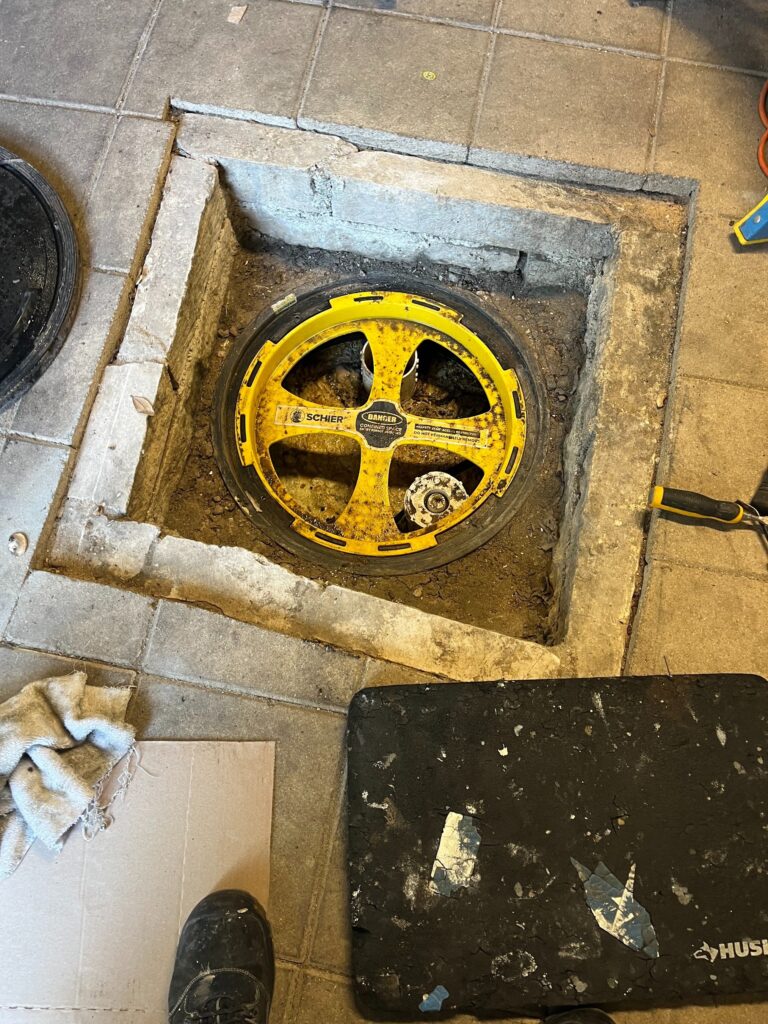
You can’t settle this from the kitchen. Please don’t lift the lid to look: the opening is a confined space that can hold hydrogen sulfide and other dangerous gases. The tee is easiest to judge once the tank has been emptied, so the person to ask is your pumping company, at the pump-out. Austin Water’s advice is to be there for it and to ask about the condition of the trap.
| What you’ve been told | What it points to | Who to call |
|---|---|---|
| The trap is overdue, and grease is packed around the tee | A pump-out problem | Your pumping company |
| The tee is plugged, but nothing on it is cracked or missing | A blockage, not damage | Your pumping company or a plumber |
| The trap was just emptied and the line past it is still backed up | Likely a blocked line past the trap, not the tee | A plumber. We offer sewer line jetting, so you can also ask us whether it fits your line |
| The tee is broken off, holed or corroded through | A repair problem | Us, for a free on-site inspection |
| The tee is missing altogether | A part that’s gone, and we fit new ones | Us, for a free on-site inspection |
| The tee looks fine, pumping is on schedule, and grease still reaches the sewer | Possibly a drain that skips the trap | Not a job we do. Ask a plumber about a dye test of the kitchen’s drains |
We don’t pump traps or haul waste, and clearing a plugged tee isn’t a repair. If the first two rows sound like yours, that’s a job for your pumping company or a plumber, not us.
What to ask your pumping company
- Is the outlet tee still there, and does its leg still reach down into the water?
- Is it plugged, or is it cracked, holed or corroded?
- After the trap was emptied, was the outlet clear?
- Will you write what you found on the manifest, and take a photo if you can?
The manifest is the record your pumping company gives you after each pump-out. On the third question, PDI-G101, an industry standard for compact interceptors, tells whoever cleans one to confirm that “inlet, outlet and air relief ports are clear of obstructions”.
Will a bad outlet tee fail an Austin grease trap inspection?
We can’t say for certain. The code sections below don’t name the outlet tee, and we haven’t found an Austin source that says inspectors check it or fail it. What the code regulates is the trap and what leaves it. Three code sections and one line of Austin Water guidance bear on your decision.
The trap has to be kept working. A restaurant “must construct, operate, and maintain a pretreatment facility approved by the director” (§ 15-10-71). For a kitchen, that facility is the grease trap, and the duty to maintain it sits with the business.
What leaves the trap has a limit. The code says: “Except as authorized by this chapter, a person may not discharge fat, oil, grease, or similar material to the POTW in excess of an instantaneous limit of 200 milligrams per liter” (§ 15-10-23). The POTW is the public sewer and treatment system. A tee exists to keep floating grease from leaving, so in our reading a trap without a working one has a harder time staying under that number.
A clog can point to the schedule. The trap must be cleaned “at least every ninety days”, or earlier once grease and solids fill 50% of the wetted height, “as measured from the bottom of the grease trap to the invert of the outlet pipe” (§ 15-10-197). The invert is the lowest inside edge of that pipe. If a tee plugged up because the trap went too long, the fix is a pump-out and a better schedule. It works the other way too: staying on schedule won’t bring back a fitting that’s gone. The waste has to go with “a liquid waste hauler permitted by the director”.
A flag on the manifest calls for action. This one is guidance on Austin Water’s maintenance page, not code, and it doesn’t leave room for waiting until the next pump-out:
“If a pump-out manifest provided to you by the LWH indicates that the GT needs repair, take appropriate action to have it serviced immediately.”
— Austin Water, Grease Trap Maintenance (LWH stands for liquid waste hauler, which is your pumping company; GT for grease trap)
If an inspection has already gone against you, here’s what to do after a failed grease trap inspection in Austin.
Can a grease trap outlet tee be repaired without a new trap?
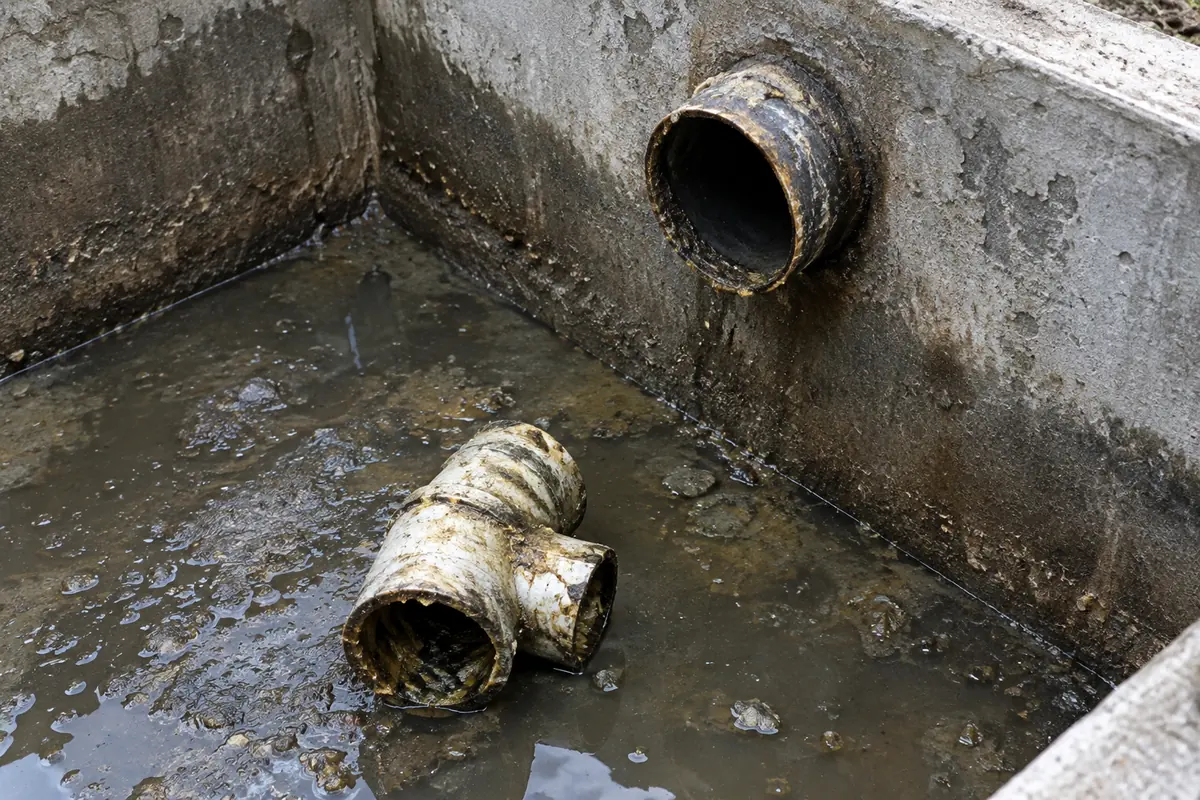
A broken or corroded tee is damage to one part, and that alone doesn’t mean the trap has to go. Most grease traps can be repaired rather than replaced. We repair T-pipes and any other part inside the trap, including baffle walls, inlet and outlet pipes, deflectors, the floor and the walls, in cast concrete, steel and fiberglass traps of all sizes, underground or above ground.
If nothing is left on the end of the outlet pipe, we fit a new tee.
- A free on-site inspection. A technician comes out and looks at the trap. A full tank makes the tee hard to judge, so when you call, mention when your next pump-out is due.
- You book your pumping company. The trap has to be emptied before the work starts, and that stays between you and them.
- We work overnight, after you close. The trap is ready the next morning, so the kitchen doesn’t have to shut. Our page on grease trap repair in Austin explains the work in full.
What comes with a grease trap repair
These promises also apply when we repair a single part like the tee, and the technician will confirm the terms for your job at the inspection. A repaired trap is guaranteed to pass inspection. What stands behind that is high industrial-grade materials, work back to the original specifications, and coordination with the city inspectors on any inspection needed. The promise is about the condition of the repaired trap. Your pump-out schedule and manifests stay in your hands. Repairs carry a 10-year warranty on labor and materials, as long as the trap gets regular pump-outs.
What does a grease trap tee repair cost?
We don’t publish prices. What you pay depends on the size of the trap and the amount of damage, and you’ll get a price for your own trap once it has been looked at. Repair typically comes to under half the cost of replacement, measured against a new trap you pay to buy and install.
When a new trap is the better answer
A bad tee doesn’t settle this on its own, but the tank around it might be past saving, or too small for the kitchen it now serves. Then replacing it is the honest answer, and we install new traps too. Austin requires building plan approval and an Industrial Waste approval letter before one is bought. Since October 1, 2026, the City’s Grease Trap Relief Program has offered qualifying and approved businesses no-cost grease trap equipment and installation or replacement, though applying doesn’t guarantee approval, so look at it first. Our guide has what to check before you replace a grease trap in Austin.
More questions about grease trap outlet tees
What is a grease trap outlet tee made of?
Under the heading “Outlet Tee is critical”, the EPA-hosted webinar lists “Minimum Schedule 40 PVC”, which is a grade of plastic pipe. That’s training material for wastewater staff and not an Austin rule. Ask your pumping company what yours is made of when the tank is empty.
How long should a grease trap outlet tee be?
Austin Water’s published design criteria don’t give a length for the tee. For new gravity interceptors, they say “the outlet must be at least 12 inches above the tank floor”. The diagram in the EPA-hosted webinar marks 12 inches between the bottom of the outlet tee’s leg and the tank floor. It marks “2/3 Depth of tank” on the inlet tee only, so don’t read that figure across to the outlet. The diagram is training material and not an Austin rule, and other cities write their own specifications.
If the tee gets repaired, will grease stop reaching the sewer?
Not if the grease is getting there another way. The EPA-hosted webinar walks through a case of a 2,000-gallon interceptor pumped every two months, with proper inlet and outlet tees and a baffle wall, that still had heavy grease in the sewer past it. The next step it gives is a dye test of the kitchen’s fixtures, which we take to mean checking whether a drain is bypassing the trap.
Sources
- Austin City Code, § 15-10-197, Requirements for cleaning grease traps (Municode, version of August 26, 2026, read November 2026)
- Austin City Code, § 15-10-23, Limit on discharge of fat, oil or grease (Municode, version of August 26, 2026, read November 2026)
- Austin City Code, § 15-10-71, Commercial or institutional food preparation (Municode, version of August 26, 2026, read November 2026)
- Austin Water, Grease Trap Maintenance (retrieved October 2026)
- Austin Water, Grease Trap Sizing and Design Criteria (design policies updated April 2021, retrieved September 2026)
- Austin Water, Grease Trap Relief Program (retrieved October 2026)
- U.S. EPA, Fats, Oils and Grease webinar slides (PDF) (NPDES Operator Webinar, October 2023)
- U.S. EPA, National Pretreatment Program fact sheet on food service establishments
- U.S. EPA, Hydrogen Sulfide Corrosion in Wastewater Collection and Treatment Systems, Report to Congress
- Plumbing and Drainage Institute, standard PDI-G101 for hydromechanical grease interceptors
- City of Bellevue, WA Utilities, Fats, Oils and Grease: How the System Works
- Schier Products, corrosion page (manufacturer, cited for one warning only)
Updated November 2026
Was your outlet tee flagged on a manifest or at an inspection?
If the report says the tee is broken or corroded, don’t sit on it: Austin Water’s word for a manifest that says the trap needs repair is “immediately”. If it says the tee is missing, we can fit a new one. Call (512) 801-4131. We’re open 24/7, and a person answers and books your free on-site inspection. If the trap is only full or the tee only plugged, your pumping company comes first, and we’re here if the trouble returns after they’ve been.